How Does the EZGO Kawasaki Engine Fuel Pump Work?
The OEM EZGO fuel pump (Part #602061) on 2008 to 2019 Kawasaki-equipped TXT and RXV models is a mechanical diaphragm pump that draws fuel from the tank using crankcase vacuum pulses generated by the engine.
Owners of electric EZGO models won’t have a fuel pump to service. For electric drivetrain diagnosis and motor replacement, see the AC vs DC Golf Cart Motors guide.A full breakdown of all engine and fuel components in this system is provided in the EZGO Golf Cart Parts Guide.
Fuel delivery on the Kawasaki 13.5-HP engine follows a simple path.
- The crankcase generates alternating pressure and vacuum pulses with each piston stroke.
- Those pulses travel through a dedicated pulse line to the fuel pump, flexing the internal diaphragm back and forth.
- Each flex pulls fuel in through the inlet valve and pushes it out through the outlet valve toward the carburetor.
The system requires no electricity: no relay, no fuse, no wiring circuit.
As long as the engine produces compression and the pulse line stays intact, the pump operates.
What Does the Pulse Line Do?
The pulse line is a short rubber hose connecting the engine crankcase to the fuel pump’s vacuum port.
Crankcase pressure fluctuations travel through it with each piston stroke, driving the diaphragm in both directions.
A cracked, loose, or collapsed pulse line completely disables the pump; even when the pump itself is in perfect condition, the diaphragm has no signal to respond to.
Why Does Diaphragm Condition Matter?
The diaphragm is a thin, flexible membrane inside the pump that flexes thousands of times per hour during normal engine operation.
Over time, rubber fatigues and stiffens.
A diaphragm that can no longer flex fully loses pumping capacity gradually, producing the progressive symptoms, hard starting first, sputtering under load next, complete starvation last, that make fuel pump failure easy to overlook until it fully fails.


How Do You Know the Fuel Pump Is the Problem?
Before ordering Part #602061, a simple field test on the EZGO TXT or RXV can confirm whether the pump is at fault or the carburetor is the real issue.
A full breakdown of all engine and fuel components, starting with diagnosis, is available in the EZGO Gas Motor Guide.
The most reliable quick test is a fuel flow check.
- Disconnect the outlet hose from the pump.
- Hold the open end of the hose into a small container.
- Crank the engine for two to three seconds.
- A healthy pump produces a strong, rhythmic stream of fuel with each engine pulse.
- Weak, intermittent dribbling, or no flow at all, confirms that the pump is not delivering correctly.
- If fuel flow looks normal at the pump outlet, the carburetor or fuel filter is the next place to look.
- If the flow is weak or absent, replace the pump and inspect the pulse line before reassembling.
Alan Bontrager found out exactly what a parts-knowledgeable team means when tracking down a fuel system issue:
“Very good service helpful in finding correct carburetor. Called me back and followed up. Delivery time fast. Will use them again.”
With more than 1,550 online reviews and a near-perfect rating, Carts & Parts connects owners with the right OEM part on the first call, not the second or third.
What Are the Steps to Replace an EZGO Fuel Pump?
Replacing the fuel pump on the 2008 to 2019 EZGO TXT and RXV Kawasaki engine is a straightforward job with basic hand tools.
Work in a well-ventilated area, keep a fire extinguisher nearby, and confirm the engine is cold before beginning.
- Disconnect the negative battery cable and allow the engine to cool completely before touching any fuel components.
- Remove the seat or rear access panel to expose the Kawasaki 13.5-HP engine and locate the fuel pump mounted on or near the engine block.
- Pinch or clamp both fuel lines, the inlet from the tank and the outlet toward the carburetor to prevent spills, then disconnect all three hose connections: inlet, outlet, and pulse line.
- Unbolt the old pump from its mounting bracket, install the new OEM Part #602061 in the same orientation, and reconnect all three hoses to their correct ports in the reverse order of removal.
- Restore the battery connection, crank the engine, and carefully inspect every hose connection for fuel leaks before returning the cart to service.
OEM vs. Aftermarket: Which EZGO Fuel Pump Is the Right Choice?
The OEM EZGO Fuel Pump Part #602061 is a factory-spec replacement built specifically for 2008 to 2019 Kawasaki engine models, and it is the only option that guarantees exact fitment and correct performance on TXT, RXV, Express, and Valor platforms.
OEM advantages:
- Diaphragm thickness and flexibility match the crankcase pulse frequency of the Kawasaki 13.5-HP engine exactly. Aftermarket diaphragms are manufactured to general small-engine tolerances, not Kawasaki-specific specs.
- The OEM pump’s pulse port diameter matches the factory pulse line without adapters or improvised clamping. A mismatched port causes an air leak at the connection point, immediately disabling the pump.
- Inlet and outlet barb sizing matches the OEM EZGO Fuel Line Hose Kawasaki EFI (PN# 666351) without modification.
Aftermarket risk:
Pulse port diameter and diaphragm stiffness vary between aftermarket suppliers.
A pump with a stiffer diaphragm than the Kawasaki crankcase pulse can flex produces sluggish, inconsistent fuel delivery, the same symptom as a worn OEM pump. Owners end up replacing the replacement.
When it comes to $15 to $20 in savings on an aftermarket pump versus a confirmed-fit OEM part, the time and frustration costs of a misdiagnosed repeat failure make the choice straightforward.

What Other Fuel System Parts Commonly Fail on the EZGO Kawasaki Engine?
Beyond the pump itself, the OEM EZGO Fuel Cap (PN# 670898) and the OEM EZGO Fuel Hose 150cc ISG EFI (PN# 680391) are the next most common replacement items in the fuel delivery system on 2008 to 2019 Kawasaki models and newer EX1-equipped platforms.
Tank side failures sit upstream of all of these. Our EZGO fuel system guide covers the tank assemblies, pickup tubes, level senders, and gauges, including how to tell a blocked cap vent from a dying pump.
> OEM EZGO Fuel Cap — PN# 670898
The OEM EZGO Fuel Cap PN# 670898 includes the cap, seal gasket, and tether. A degraded cap seal creates two failure modes.
- First, a loose or cracked seal allows fuel vapors to escape, creating a fuel odor even without a visible leak.
2. Second, a blocked cap vent produces a vacuum lock inside the fuel tank as the engine draws fuel down.
The resulting negative pressure starves the pump, exactly as a failed diaphragm does: hard starting, progressive power loss, and stalling.
> OEM EZGO Fuel Hose 150cc ISG EFI — PN# 680391
The OEM EZGO Fuel Hose 150cc ISG EFI (PN# 680391) fits EFI-equipped ISG models and connects the fuel delivery system on carts transitioning from the Kawasaki 13.5-HP to the EX1 150cc ISG engine.
A cracked hose on an EFI system allows air into the fuel rail, causing misfires and hard starts that no amount of carburetor cleaning can resolve.
Kevin Heaney had an intermittent issue with his three-year-old EZGO gas cart that required the kind of diagnosis only a knowledgeable service team can deliver:
“Outstanding Service today. I had an electrical issue with my three year old EZGO Gas Cart. Starting with my purchase from Jeff three years ago to both Cole and Cade taking care of my problem today. Called and talked to Cole yesterday. He said to bring it by today and wait on it. Should only take about 60 Minutes. He thought it could be one of three things. I live 90 minutes away and thought it would require two trips. Arrived at 10:00 am and left at 11:00 am. Problem taken care of along with a tuneup and service. Fantastic customer service from a Family that cares.”
How Do You Test a Fuel Pump on an EZGO Golf Cart?
Testing the OEM fuel pump (Part #602061) on an EZGO TXT or RXV with a Kawasaki 13.5-HP engine takes about five minutes and requires only a clean rag, a small container, and a second person to crank the engine while you observe fuel flow.
Step 1: Confirm fuel and filter first.
Before touching the pump, verify that the tank has at least a quarter of a tank of fresh fuel.
A clogged inline fuel filter produces symptoms identical to those of a failed pump. Replace the filter before condemning the pump if it hasn’t been changed recently.
Step 2: Disconnect the outlet line.
With the engine cold and the battery disconnected, remove the hose from the pump’s outlet port, the line going toward the carburetor.
Direct the open end into a small container.
Step 3: Reconnect the battery and crank the engine.
Have a helper crank the engine for two to three seconds while you observe the outlet port.
A functioning pump produces a strong, steady stream with clear rhythmic pulsing.
Weak dribbling, intermittent spurts, or a lack of flow indicate that the diaphragm is no longer functioning properly.
Step 4: Check the pulse line.
If the outlet test shows weak flow, inspect the pulse line connecting the engine crankcase to the pump’s vacuum port.
Cracks, loose clamps, or a collapsed hose disable the pump entirely, even when the diaphragm is intact.
Proper fuel system practices, including hose inspection intervals, align with maintenance guidance published by the U.S. Environmental Protection Agency.
Step 5: Interpret the results.
Strong flow at the pump outlet indicates the pump is working.
Check the carburetor or fuel delivery lines next.
Weak or absent flow indicates a problem at the pump diaphragm, the pulse line, or both.
How Often Should You Replace the Fuel Pump on an EZGO Gas Cart?
The OEM EZGO fuel pump (Part #602061) does not carry a fixed mileage or hour replacement interval in EZGO/Textron service documentation.
Still, technicians working on Kawasaki 13.5-HP engines consistently recommend inspecting the pump diaphragm, pulse line, and hose connections at every major service interval, typically once per season or every 100 hours of operation.
Several conditions accelerate diaphragm wear:
Ethanol fuel exposure.
E10 gasoline containing 10% ethanol degrades rubber diaphragms faster than ethanol-free fuel.
The ethanol absorbs moisture over time, and the combination of alcohol and water accelerates rubber stiffening and micro-cracking from the inside out.
Extended storage without a stabilizer.
Stale gasoline left in the fuel system over winter forms varnish deposits that coat the pump’s diaphragm and check valves.
Gum deposits reduce check valve seating, causing the pump to lose output pressure even before the diaphragm physically fails.
Running the tank low repeatedly.
A near-empty tank allows the pump to draw air during aggressive acceleration.
Air cycling through the diaphragm introduces thermal stress not present during normal liquid pumping.
Accurate fuel-level monitoring starts with a reliable gauge.
Two OEM options cover different model years: the OEM EZGO Fuel Level Gauge (PN# 648247) fits 1996 to 2020 TXT, 2010 to 2019 Valor and Terrain, and 2012 to 2021 Express Gas and EFI models.
The OEM EZGO Fuel Level Gauge (PN# 21553G1) covers additional model configurations. A working gauge prevents the low-tank running habits that shorten pump life.
According to maintenance principles outlined by SAE International, regular inspection of fuel delivery system components, including pump diaphragms, hoses, and sealing surfaces, is standard practice for small-engine longevity.
What Happens If You Ignore a Failing EZGO Fuel Pump?
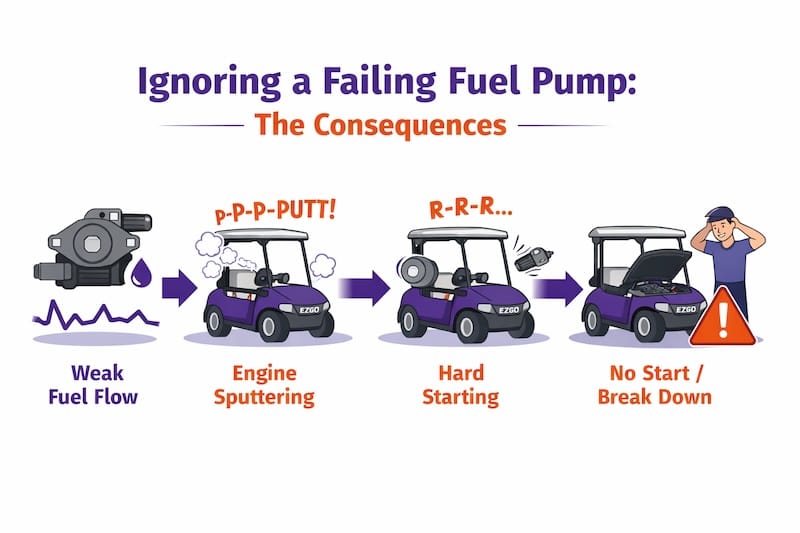 Fuel delivery problems rarely resolve on their own. A diaphragm that has started cracking will not stabilize; degradation accelerates.
 - Fuel starvation causes the Kawasaki 13.5-HP engine to run lean, raising combustion temperatures and accelerating valve seat wear that leads to costly internal engine repairs.
- Intermittent stalling under load during utility operation creates unpredictable, unsafe stops, a problem that worsens as the pump degrades further.
- A failing diaphragm that begins passing fuel internally allows raw gasoline to enter the crankcase, diluting the oil and accelerating wear on bearings, rings, and cylinder walls.
- Secondary failures in the carburetor, fuel filter, and fuel lines follow when a degraded pump forces adjacent components to compensate for inconsistent delivery pressure.
A new OEM Part #602061 addresses all four failure paths at once.
What Does a Fully Serviced EZGO Fuel System Look Like?
A properly serviced EZGO TXT or RXV with a fresh Kawasaki engine fuel system delivers a noticeably different ownership experience not just once, but every time the key turns.Greg Hier found exactly what nationwide availability from a knowledgeable parts source means:
“Great price and free shipping. Shipped fast. Great communication. Cade was awesome. I’m in Texas but they might be my go-to parts source.”
A fully serviced EZGO fuel system produces these results:
- The engine starts on the first or second crank every time, even after extended storage, because fuel reaches the carburetor at full delivery pressure immediately.
- Smooth, consistent power through the full throttle range on the Kawasaki 13.5-HP engine with no sputtering, hesitation, or mid-throttle stumble under load.
- During extended operation, the pump maintains a steady delivery volume, even as demand increases.
- Fuel Level Gauges (PN# 648247 and PN# 21553G1) read accurately at all times, providing a reliable indication of remaining fuel and helping prevent low-tank running, which shortens pump and carburetor service life.

Get Professional EZGO Fuel Pump Service and OEM Parts
Carts & Parts is an authorized EZGO dealer in Union City, Indiana, serving customers nationwide with a full inventory of OEM parts and an in-house service department that handles Kawasaki engine diagnosis and repair.
Free shipping on orders over $50.
Call (937) 459-8891 to order the right part today.