What Is a DC Golf Cart Motor and How Does It Work?
DC series motors and DC separately excited (Sepex) motors power EZGO TXT, Marathon, and Express S4 carts by drawing direct current from a 36V or 48V battery pack through a brush-and-commutator assembly.
The brushes make physical contact with a rotating commutator ring, which switches the direction of current through the motor windings to produce continuous rotation. Torque output in a DC series motor increases with load, which is why these motors feel strong off the line.
DC motors dominated golf cart drivetrains for decades because they’re straightforward to diagnose and repair. Any technician with a multimeter and basic wiring knowledge can test a DC motor in the field.
The brush-and-commutator system is also the DC motor’s biggest limitation. Brushes wear down over time, especially under heavy use. When brush material wears thin, current transfer becomes inconsistent. Owners notice sparking, a burning smell, or progressive power loss before complete failure.
Gas-powered EZGO models use a different drivetrain path — internal combustion power transfers through a clutch and belt rather than an electric motor. For those models, see the EZGO Golf Cart Gas Motor & Engine Parts Guide for complete drivetrain coverage including drive belts, clutch systems, and engine components.
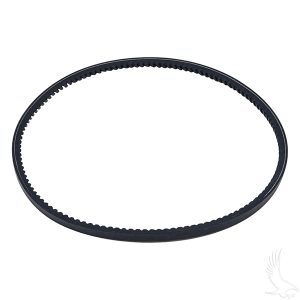
Gas carts also use a drive belt to transfer power — if your Kawasaki-powered TXT or RXV gas cart needs one, the OEM EZGO Drive Belt guide is best for you.
What Are the Pros and Cons of a DC Golf Cart Motor?
Pro: Lower upfront replacement cost. DC motors are less expensive to manufacture than AC motors because they require no inverter. Lower material cost means a lower purchase price for the replacement motor.
For owners of older TXT models keeping a cart running on a budget, DC is the practical path.
Pro: Simple field diagnosis. A DC motor can be tested with basic tools. Checking brush length, commutator condition, and winding resistance gives a clear picture of motor health without specialized diagnostic equipment. Quick diagnosis means faster repairs and less time off the road.
Con: Brush wear requires periodic inspection. Brushes in a DC series motor wear down with use. High-load conditions — heavy passengers, steep terrain, frequent stop-and-go use — accelerate brush wear significantly. Waiting until the motor fails completely is always more expensive than catching brush wear early.
Con: Power loss under sustained load. DC motors generate heat under sustained load, and that heat reduces efficiency. Extended hill climbs or heavy cargo loads cause DC motors to lose torque progressively as the motor warms. AC motors maintain consistent output under the same conditions.

OEM EZGO 36-Volt DC Motor — Part #750439PKG
The OEM EZGO Golf Cart 36-Volt Electric Motor (Part #750439PKG) is the factory-correct DC replacement motor for 36V EZGO TXT platforms.
Using the genuine E-Z-GO motor ensures exact fit, correct brush specifications, and full compatibility with the existing 36V controller and wiring harness — no adapter work, no compatibility guesswork.
What Is an AC Golf Cart Motor and How Does It Work?
AC induction motors power the EZGO RXV platform by using an on-board inverter to convert 48V DC battery power into three-phase alternating current, which the Curtis or Danaher controller uses to regulate speed, torque output, and regenerative braking behavior.
Unlike a DC motor, the AC motor has no brushes and no commutator. Current flows through stationary stator windings and induces rotation in the rotor without any physical contact between parts. Fewer contact points mean significantly less mechanical wear over the life of the motor.
The controller is not a passive component in an AC system — it actively manages every aspect of motor behavior. Acceleration curves, top speed limits, regenerative braking force, and fault protection all run through the controller’s programming.
An AC motor paired with the wrong controller either won’t operate at all or will produce fault codes and erratic behavior.
Regenerative braking is the most practical advantage of AC systems for everyday use. When the driver lifts off the accelerator, the AC motor switches into generator mode, converting kinetic energy back into electrical energy and returning it to the battery pack.
Over a full day of use with frequent stops, this energy recovery extends driving range meaningfully. For more on how the motor brake works within the RXV AC system, the EZGO RXV Motor Brake Replacement & Troubleshooting Guide covers the electromagnetic brake component that works alongside the AC motor for hill-hold and parking security.
What Are the Pros and Cons of an AC Golf Cart Motor?
Pro: Brushless design means minimal wear. No brushes means no brush maintenance, no commutator scoring, and no gradual performance decline from contact wear.
An AC motor’s mechanical lifespan is significantly longer than a comparable DC motor under the same operating conditions. Owners of RXV carts often run original factory motors for ten or more years without motor-specific service.
Pro: Regenerative braking extends battery range. Every time the driver decelerates, the AC system captures energy that would otherwise be lost as heat in a DC system. On a route with frequent stops or repeated hill descents, the energy recovered through regenerative braking can add meaningful range to each charge cycle.
Pro: Consistent torque on hills and under load. The AC motor maintains steady torque output regardless of sustained load, because the controller actively manages current delivery to compensate for changing conditions. A fully loaded RXV climbing a grade holds speed far more consistently than a DC-powered cart under the same conditions.
Con: Higher upfront cost. AC motors, inverters, and compatible controllers cost more than their DC counterparts. The total system cost of an AC platform — motor plus controller — is higher than a DC replacement of equivalent size.
For owners replacing a failed motor on an older DC cart, AC conversion is rarely cost-effective.
Con: Requires a compatible AC controller. Swapping only the motor without replacing the controller on a DC platform does not produce a functional AC system. The motor, controller, and wiring must be matched to the same AC specification.
Does an AC golf cart motor require a different controller?
Yes. An AC induction motor requires a dedicated AC motor controller — such as the Curtis 1234 or Danaher series controller used in factory EZGO RXV builds — to function. The controller converts battery DC power to three-phase AC and manages all motor functions including speed regulation and regenerative braking. A standard DC controller cannot drive an AC motor. On RXV models, always replace the motor with an OEM AC unit matched to the existing controller to ensure proper operation.

OEM EZGO 48-Volt AC Motor Kit — Part #671143
The OEM EZGO Golf Cart 48-Volt AC Electric Motor Kit (Part #671143) is the factory-correct AC motor replacement for compatible EZGO platforms. The kit format includes the motor and associated hardware for a complete service installation.
Using the genuine E-Z-GO AC motor guarantees controller compatibility and proper regenerative braking behavior — two specifications that aftermarket AC motors frequently get wrong.
Robert Toles searched online for an OEM motor brake for his EZGO RXV and found exactly what he needed at Carts & Parts:
“Search the online for a new Motor Brake for my EZGO RXV. Carts & Parts had the OEM part at a great price. I’m someone that’s a little leery of order in anything online for the obvious reasons. The Part arrived fast and was exactly what I had expected, an original OEM part. I’m extremely happy with the service I received and would recommend Carts & Parts as a company you can trust. 5 🌟” — Robert Toles

AC vs DC Golf Cart Motors: Which One Is Right for Your EZGO?
The answer depends entirely on the EZGO platform you own. TXT and Marathon carts use DC series motors as factory equipment. The RXV, introduced in 2008, runs on a factory-engineered AC system from the ground up. Express S4 models use high-output 48V DC motors built for passenger load capacity.
Matching motor type to platform isn’t optional — it’s a hard requirement. Replacing an RXV AC motor with a DC unit voids the regenerative braking system, disables the motor brake circuit, and causes immediate controller fault codes.
Going the other direction — installing an AC motor on a TXT without upgrading the controller produces the same result.
Once you know your platform, the EZGO electric motor replacement guide walks through the OEM part number for each one, from the 36V PDS TXT to the Express S4 High Output and the RXV AC kits.
According to the U.S. Department of Energy, AC induction motors typically achieve efficiency ratings of 90 to 95 percent in industrial and vehicle applications, compared to 70 to 85 percent for series-wound DC motors operating under variable load conditions.
OEM EZGO 48-Volt DC Motor — Part #750438PKG
The OEM EZGO Golf Cart 48-Volt Electric Motor (Part #750438PKG) is the factory-correct DC replacement motor for 48V EZGO TXT platforms.
Genuine E-Z-GO specifications ensure the correct brush grade, winding resistance, and shaft dimensions for a direct drop-in replacement with no modifications required.
The 750438PKG kit contains the 624105 motor assembly and the 627215 O-ring plug kit, so it is the same Advanced Motors & Drives motor, packaged for a full-service replacement with fresh seals.
Kevin Heaney drove 90 minutes to Carts & Parts with an electrical issue on his EZGO gas cart and left in an hour with the problem solved:
“Called and talked to Cole yesterday. He said to bring it by today and wait on it. Should only take about 60 Minutes. He thought it could be one of three things. I live 90 minutes away and thought it would require two trips. Arrived at 10:00 am and left at 11:00 am. Problem taken care of along with a tuneup and service. Fantastic customer service from a Family that cares.” — Kevin Heaney
How Do I Know If My Golf Cart Has an AC or DC Motor?
EZGO RXV carts built from 2008 onward come standard with a factory AC induction motor. TXT and Marathon carts use DC series motors unless previously converted. Identifying which system your cart has takes less than two minutes.
Follow these steps:
- Check the model. If your cart is an RXV with a manufacture date of 2008 or later, you have an AC motor.
- Locate the motor. On electric carts, the motor sits directly behind or beneath the rear seat, connected to the rear axle transaxle.
- Look at the motor end cap. DC motors have a removable brush end cap, usually with two to four hex screws around the perimeter. AC motors have a sealed housing with no brush access point.
- Check the controller label. Curtis 1234 or Danaher labels indicate an AC system. Older Curtis 1268 or GE labels indicate DC.
- Read the serial number plate. Locate the white sticker near the driver’s side rear wheel or under the seat. The model year and platform code confirm the drivetrain type. Contact Carts & Parts at (937) 459-8891 if you need help decoding your serial number.
OEM EZGO 48-Volt SE Motor with O-Ring Kit — Part #750440PKG
The OEM EZGO Golf Cart 48-Volt SE Motor with O-Ring Kit (Part #750440PKG) includes the motor and a complete O-ring seal kit for a full service replacement. The SE designation indicates a separately excited (Sepex) DC motor configuration, which provides smoother speed control than a standard series motor. Correct O-ring sealing prevents moisture intrusion in the motor housing, protecting windings from corrosion damage.
Can You Convert a DC Golf Cart to AC?
Converting an EZGO TXT or other DC-powered cart to AC requires replacing the motor, upgrading to a compatible AC controller, and confirming that the existing wiring harness supports the new system’s voltage and signal requirements. The motor swap alone does not create a functional AC drivetrain.
The RXV platform is already AC from the factory, so motor replacement on those carts is straightforward: install the correct OEM AC motor matched to the existing Curtis or Danaher controller, and the system operates exactly as designed. For TXT owners considering an AC upgrade, the economics deserve careful evaluation. The total cost of an AC motor, a matched controller, and any harness modifications typically exceeds the value of the upgrade on a cart that wasn’t designed for AC from the ground up.
⚠️ Important: Installing an AC motor on a DC platform without replacing the controller will not produce a working AC system. The controller must be upgraded to a compatible AC unit at the same time. Attempting to run an AC motor on a DC controller will result in immediate controller faults and no drive output.
A few practical guidelines for the conversion decision:
- RXV with failed AC motor: Always replace with OEM AC motor. Do not substitute a DC motor.
- TXT with failed DC motor: Replace with the correct OEM DC motor for the platform. Evaluate AC conversion separately as a performance upgrade project, not a like-for-like repair.
- TXT performance upgrade to AC: Budget for motor, controller, and wiring. Expect a full-day installation. Verify harness compatibility before ordering parts.
According to the National Highway Traffic Safety Administration (NHTSA), low-speed vehicles including golf carts are subject to federal safety standards when operated on public roads, and drivetrain modifications affecting speed or braking performance may require re-certification under applicable regulations.
OEM EZGO 48-Volt Express S4 High Output Motor — Part #628660
The OEM EZGO Golf Cart 48-Volt Electric Motor (Express S4 High Output, Part #628660) is the factory-correct DC replacement motor for the Express S4 platform. The high-output designation reflects the motor’s design for multi-passenger loads — more amperage capacity and heavier-duty winding construction than a standard TXT motor. Using the OEM Express S4 motor ensures the cart handles its rated passenger and cargo capacity without motor strain.
Jim McGaha expected to need a complete motor replacement on his cart — until the team at Carts & Parts found the real problem:
“These guys are very honest and helpful with my cart repairs. I was expecting a replacement engine and they found other things wrong saving me close to a thousand dollars who can complain about that. Turn around time is the best less than 2 weeks. Great people to deal with I wish I could give more stars. HIGHLY RECOMMENDED” — Jim McGaha
What Happens If You Choose the Wrong Motor?
Mismatched motors don’t just underperform — they fail fast and take other components with them. Installing the wrong motor type, voltage rating, or shaft specification on an EZGO creates a chain of problems that an OEM replacement would have prevented entirely.
- Controller damage: An AC motor paired with a DC controller draws unregulated current. The controller overheats and fails within hours or days of operation.
- Wiring damage: Incorrect voltage ratings create resistance mismatches that cause wiring insulation to overheat and degrade at connectors and termination points.
- Repeated failures: Aftermarket motors built to looser tolerances wear out faster under load, leading to a second replacement within months of the first.
- Safety risks: A motor that loses torque unexpectedly on a slope — due to wrong brush grade or thermal overload — creates a real stopping hazard.
OEM motors are engineered to the exact specification of your EZGO platform. The brush grade, winding resistance, shaft diameter, and mounting bolt pattern all match the factory drawing. Aftermarket alternatives may share the same general dimensions but rarely match every specification that matters for long-term reliability.
OEM EZGO 48-Volt AC Electric Motor — Part # 680638
The OEM EZGO Golf Cart 48-Volt AC Electric Motor (Part #680638) is a factory AC motor replacement for compatible 48V EZGO AC platforms. The genuine E-Z-GO motor guarantees correct winding specifications and inverter interface compatibility for proper controller communication. Replacing a failed AC motor with this OEM unit restores full regenerative braking function and factory acceleration behavior.
💡 Tip: Before ordering a replacement motor, confirm your cart’s serial number and model year. Even within the same platform, motor specifications changed across production years. Carts & Parts can match the correct motor to your serial number — call (937) 459-8891 before ordering if you’re unsure.
What Does the Right Motor Feel Like?
When the correct OEM motor is installed and properly matched to the controller, the difference is immediate and consistent. Owners notice it the first time they drive.
- Smooth, predictable acceleration from a standing start without the hesitation or lurch that a worn or mismatched motor produces.
- Full power maintained on hills — no speed loss mid-climb when the cart is loaded with passengers and cargo.
- Quiet operation without the electrical buzzing, sparking sounds, or periodic power interruptions that signal brush wear or winding degradation.
- Longer range per charge — an AC motor recovering energy on every deceleration, or a DC motor in good condition with new brushes, draws less current than a worn motor struggling to maintain output.
Every mile your EZGO cart travels with the right motor in place is a mile without an unplanned stop, a service call, or a replacement cost you hadn’t budgeted for. For a complete overview of every EZGO component category, the EZGO Golf Cart Parts Guide covers electrical, drivetrain, body, and safety systems in a single resource.
Get Professional EZGO Motor Service and OEM Parts
Carts & Parts is an authorized E-Z-GO dealer serving East Central Indiana and Western Ohio, with more than 2,000 five-star reviews from customers across the country. Every OEM motor ships free on orders over $50. No hidden fees, no aftermarket guesswork — just the exact E-Z-GO part your cart was built with.
Call Us (937) 459-8891 to confirm the right motor for your model year, or order directly from the product links above.