
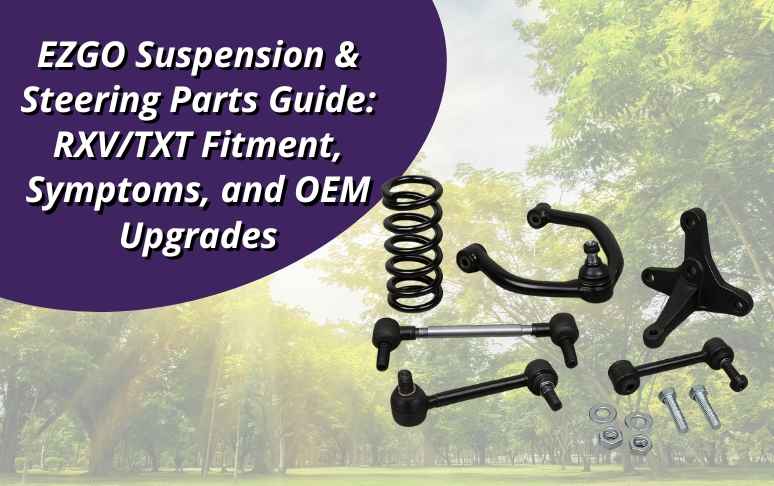
EZGO suspension and steering parts are the components that connect an EZGO golf cart’s chassis to its wheels, allowing it to turn and providing a smooth ride.
Contents
ToggleKey parts include steering components like the steering wheel, steering column, and steering box, as well as suspension components such as leaf springs, shock absorbers, bushings, and ball joints.
These parts are essential for golf cart stability, control, and comfort while driving.
But sometimes things go wrong.
- Worn suspension bushings turn every bump into a jarring impact.
- Loose steering creates steering play and unpredictable handling that can quickly become unsafe.
- Strange clunking noises announce your arrival before anyone sees you coming.
Suspension and steering components directly affect your cart’s safety, handling, and ride comfort. When these parts wear out, performance suffers immediately.
This guide walks you through everything you need to know about EZGO suspension and steering parts.
You’ll learn how to diagnose problems early, understand the differences between RXV and TXT components, choose between OEM and aftermarket parts, and decide when upgrades make sense.
We’ll cover bushing replacement, A-arm fitment, steering yoke assemblies, and the maintenance schedule that extends your cart’s lifespan by decades.
-
- Worn suspension components degrade handling and cause uneven tire wear.
- OEM components guarantee exact fitment and longevity.
- Early replacement prevents expensive cascading component failures.
EZGO Suspension & Steering Parts: What Each Component Does
Understanding the key components helps you identify problems and communicate clearly with parts suppliers and mechanics.
Steering System Components
Knowing what each steering part does helps you identify wear symptoms and order the correct replacement components.
- Steering Wheel: The control interface you grip and rotate to change direction.
- Steering Column: The vertical shaft connecting the steering wheel to the steering gear below. Houses the main rotating shaft and support bearings.
- Steering Gear Box/Rack and Pinion: A mechanical assembly that converts steering wheel rotation into sideways movement. The rack moves left or right as you turn the wheel, pushing or pulling the tie rods.
- Tie Rods: Metal rods connecting the steering rack to both front wheels. Ensure wheels turn together in the correct direction and maintain proper alignment.
- Steering Yoke: Connects the steering column to the rack-and-pinion input shaft. Transfers rotational force while allowing for suspension movement.
- Steering Knuckles: Pivot points where the wheels attach to the suspension. Allow the wheels to turn left and right while supporting the vehicle’s weight.
Suspension System Components
Understanding suspension parts helps you diagnose ride quality issues and choose the right replacement components for your specific model.
- Leaf Springs: Curved metal strips stacked together that sit above the axles. Flex under load to absorb impacts from bumps and uneven terrain. TXT models use leaf springs front and rear, while RXV models use them only in the rear.
- Shock Absorbers: Hydraulic dampers that control spring oscillation. Prevent excessive bouncing by converting kinetic energy to heat through internal fluid resistance.
- Bushings: Cylindrical rubber or polyurethane sleeves pressed into suspension pivot points. Isolate vibration, reduce noise, and prevent metal-to-metal contact that accelerates wear.
- A-Arms (Control Arms): A-Arms are the triangular suspension components that connect the wheel spindle to the frame at two pivot points. Maintain proper wheel alignment through suspension travel. Used on the RXV front suspension.
- Ball Joints: Spherical bearings that allow multi-axis movement. Connect the steering knuckles to the control arms, allowing the wheels to turn for steering while the suspension moves up and down.
- Wheel Hubs: Central mounting point where the wheel attaches to the axle. Contains bearings, seals, and mounting hardware that allow smooth wheel rotation.