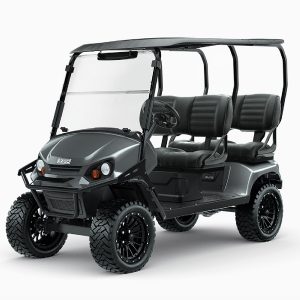
Why Most Standard Golf Carts Do Not Have Seat Belts
Standard EZGO, Club Car, and Yamaha golf carts ship without seat belts because manufacturers design them for recreational use on private courses rather than public road operation.
How Golf Carts Were Originally Designed for Course Use
Golf cart engineers prioritized convenience over restraint systems.
Players needed to hop in and out of the game quickly between shots. Carrying clubs required easy access to the rear platform.
Speeds rarely exceeded 12-15 mph on maintained turf. Smooth fairways and cart paths presented minimal ejection risk. Open sides allowed golfers to step out without fumbling with buckles.
The original design made perfect sense for its intended purpose.
How Neighborhood and Street Use Changed Golf Cart Safety
Retirement communities discovered golf carts offered perfect neighborhood transportation. Resorts adopted them for guest shuttles. Commercial facilities used them for employee transport across large campuses.
Paved roads and higher speeds dramatically changed the safety equation. A cart traveling 20 mph on asphalt creates entirely different forces than one crawling across grass at 10 mph.
Federal regulators responded by classifying faster carts as Low-Speed Vehicles, subject to mandatory safety requirements. Seat belts became essential equipment rather than optional accessories.

Federal Seat Belt Requirements for Golf Carts and LSVs
The Federal Motor Vehicle Safety Standards (FMVSS), administered by the NHTSA, require seatbelts at every designated seating position for any vehicle classified as a Low-Speed Vehicle (LSV).
What Is a Low-Speed Vehicle (LSV)?
LSVs occupy a specific category under federal law. The maximum speed of these vehicles ranges from 20 to 25 mph.
Anything slower remains a standard golf cart. Anything faster requires full compliance with automotive safety standards.
Required LSV equipment includes headlights, brake lights, turn signals, side mirrors, a windshield, a parking brake, reflectors, and seat belts at every seat.
Registration, insurance, and a valid driver’s license complete the legal requirements.
The 17-digit VIN identifies the vehicle for titling and registration purposes.
Without proper documentation, DMV offices cannot process street-legal registration.
When Do Seat Belts Become Legally Required?
Any cart modified to exceed 20 mph automatically triggers LSV classification.
Performance upgrades, such as controller modifications or motor swaps, often push carts into this category.
Public road operation requires LSV compliance in most jurisdictions.
Even communities that permit golf carts on certain streets typically mandate safety equipment.
Commercial transportation applications face the strictest requirements. Resort shuttles, campus vehicles, and rental fleets must meet all applicable safety standards.
Universal Side View Mirrors complete your street-legal equipment package, along with seat belts.
NHTSA publishes complete LSV safety standards for reference.
How Do Golf Cart Seat Belt Laws Vary By State?
Golf cart seat belt laws vary significantly across Florida, California, Georgia, South Carolina, and Arizona, with some states deferring entirely to local municipalities for regulation.
States With Specific Golf Cart Seat Belt Requirements
Florida presents the most complex regulatory landscape. LSVs registered for street use must comply with the Florida Safety Belt Law, which requires restraints for all occupants.
Traditional golf carts that travel under 20 mph are exempt from state seatbelt requirements, but local ordinances may differ significantly.
South Carolina enacted new legislation in 2025 requiring fastened seat belts for all children under 12 years old when operating on public streets and highways.
Fines up to $25 apply for violations. Law enforcement has discretion during the initial phase-in period.
North Carolina mandates seat belt use for all passengers operating on secondary streets with speed limits of 35 mph or less. Carts must also display proper lighting for daytime operation.
Arizona requires all LSVs to comply fully with federal seat belt requirements. Standard golf carts may operate on roads not exceeding 35 mph without seat belt mandates at the state level.
States That Leave Golf Cart Laws to Local Governments
California has no state law governing seat belt use in golf carts. Individual communities establish and enforce their own requirements.
Some gated communities mandate seat belts, while others have no restrictions.
Georgia allows cities and towns throughout the state to independently govern golf cart use.
Peachtree City maintains one of the nation’s most extensive golf cart path networks, with strict safety ordinances, including seat belt requirements.
| State | Seat Belts Required? | Requirement Details | Notes / Exceptions |
|---|---|---|---|
| Alabama | Conditional | Seat belts are required only for street-legal LSVs. | Must comply with LSV equipment laws. |
| Alaska | No | Seat belts are not required on golf carts. | Golf carts are not permitted on most public roads. |
| Arizona | Yes | Seat belts are required on street-legal golf carts. | LSV classification applies. |
| Arkansas | No | No state-level seat belt requirement. | Local ordinances may differ. |
| California | Yes | Seat belts are required if operating as an LSV/NEV. | Public road use only. |
How to Choose the Right Golf Cart Seat Belt Kit
Choosing between retractable lap belts, fixed two-point systems, and complete four-passenger kits depends on your cart model, passenger needs, and intended use.
Retractable belts offer convenience for frequent entry and exit.
Fixed belts cost less and function reliably for decades. Four-passenger kits address front and rear seating in a single purchase.
Model compatibility matters significantly. EZGO TXT frames differ from EZGO RXV mounting points.
Club Car Precedent configurations require different brackets than DS models. Proper fitment prevents belt failure during accidents.
When Ed Nelson purchased his first golf cart, he discovered the importance of working with experts who understand both safety and service:
“The owners of Carts and Parts have the highest integrity and stand by their words. My purchase experience was 5 star and it was a pleasure doing business with Cade and his family. This is my first golf cart purchase and I strongly believe that I knocked it out of the park because of Carts and Parts customer service. EZ GO is an industry leader and they found an industry leader dealer with Carts and Parts.”
With more than 1,550 online reviews and a near-perfect rating,
Carts & Parts helps owners select the correct seat belt kit for their specific cart model and application.
EZGO Golf Cart Accessories include complete seat belt options for all model years.
Your Action Plan for Adding Golf Cart Seat Belts
Getting seat belts installed on your golf cart follows a straightforward process:
- Determine your cart classification. Measure top speed to identify whether you own a standard golf cart (under 20 mph) or an LSV (20-25 mph). Classification determines which regulations apply.
- Check local regulations. Contact your county or municipality for specific seat belt requirements. HOA rules may impose additional obligations on community operations.
- Select the appropriate kit. Match belt type (retractable vs. fixed) to your seating configuration and model year. Front-only kits work for two-passenger carts, while four-passenger kits cover rear seats.
- Schedule professional installation. Proper anchoring to the frame prevents belt failure during an accident. Certified technicians ensure correct torque specifications and bracket placement.

What Types of Seat Belts Work Best for Golf Carts?
Two-point lap belts, retractable lap belts, and three-point harnesses each serve a different purpose in golf cart safety applications.
How Do Two-Point Lap Belts Work?
Fixed lap belts represent the simplest and most affordable option.
Adjustable webbing accommodates different body sizes. Lengths range from 48 to 74 inches, depending on the kit selected.
Installation requires mounting both ends to the seat frame or cart chassis. Push-button or lift-lever buckles release quickly for exit. Durable nylon webbing withstands years of outdoor exposure.
Budget-conscious owners often start with fixed lap belts for basic compliance.
Why Choose Retractable Lap Belts?
Retractable mechanisms automatically wind the belt when unbuckled. No loose webbing dangles or gets stepped on.
Passengers simply pull the belt across and click into the receiver.
Extension lengths range from 42 to 53 inches to comfortably fit larger passengers.
The retractor housing mounts behind the seat back, keeping components protected from weather and debris.
Pro-Fit 2-Passenger Retractable Seat Belt Kit fits most EZGO, Club Car, and Yamaha two-seat configurations.
Seat Belt Options for Four-Passenger Golf Carts

Complete four-passenger kits include belts and brackets for front and rear seating positions.
Purchasing a complete kit costs less than buying components separately.
OEM EZGO kits designed specifically for RXV and TXT models ensure factory-quality fitment. Universal kits require bracket modifications but work across multiple brands.
Pro-Fit Retractable 4-Passenger Seat Belt Kit covers all seating positions with matching hardware.

How Do You Install Seat Belts on a Golf Cart?
Installing seat belts on an EZGO TXT, EZGO RXV, Club Car Precedent, or Yamaha Drive requires proper anchoring to the seat frame or cart chassis for reliable performance.
Basic Golf Cart Seat Belt Installation Steps
Professional installation follows a consistent process across most models:
- Position the mounting bracket behind the seat back at the correct height.
- Mark anchor points and drill through the frame using appropriate bit sizes.
- Install heavy-duty bolts with backing plates to distribute the load.
- Thread the belt through the bracket slot and secure with the provided hardware.
- Test the retraction mechanism and latch engagement before use.
Proper hole placement prevents interference with seat adjustment mechanisms.
Backing plates spread force across larger frame areas to prevent pull-through during accidents.
Why Professional Installation Improves Safety and Compliance
Torque specifications ensure bolts remain tight under stress.
Over-tightening cracks frames. Under-tightening allows movement that leads to failure.
Frame inspection identifies rust, cracks, or weak points before drilling.
Damaged frames may require reinforcement before seat belt installation.
Warranty coverage from quality manufacturers requires authorized installation. DIY mounting may void product warranties and expose the company to liability.
4-Passenger RFS Pro Seatbelt Kit RXV includes complete hardware for proper EZGO RXV installation.
Jim McGaha experienced firsthand how Carts & Parts technicians approach every job with honesty and expertise:
“These guys are very honest and helpful with my cart repairs. I was expecting a replacement engine and they found other things wrong saving me close to a thousand dollars who can complain about that. Turn around time is the best less than 2 weeks. Great people to deal with I wish I could give more stars. HIGHLY RECOMMENDED”

Are Seat Belts Required on Golf Carts?
Seat belt requirements for golf carts depend on vehicle classification, operating location, and applicable state or local laws governing your specific situation.
Federal law requires seat belts on all Low-Speed Vehicles (LSVs) capable of speeds between 20 and 25 mph. Standard golf carts limited to under 20 mph fall outside federal LSV requirements at the national level. State and local regulations may impose additional requirements regardless of speed capability.
Florida exempts traditional golf carts from state seat belt requirements, but registered LSVs must comply with the Florida Safety Belt Law.
South Carolina enacted legislation in 2025 requiring children under 12 to wear seat belts on public roads.
North Carolina mandates seat belt use for all passengers on secondary streets.
Property owners, HOAs, and commercial facilities may implement their own seat belt policies independent of government requirements.
Insurance companies increasingly recommend seat belts to reduce liability exposure and may offer premium discounts for equipped vehicles.
CPSC Golf Cart Safety provides additional information about injury statistics and safety recommendations.
Can You Add Seat Belts to an Existing Golf Cart?
Aftermarket seat belt kits from manufacturers like RHOX, Madjax, GTW, and OEM EZGO can be installed on virtually any golf cart model, regardless of original equipment.
Most golf carts accommodate seat belt installation through existing seat mounting points or dedicated bracket systems.
Retractable kits for EZGO TXT, EZGO RXV, Club Car DS, Club Car Precedent, and Yamaha G29/Drive models include model-specific hardware for a precise fit.
Universal seat belt brackets mount behind the seat back and anchor through the cart frame using heavy-duty fasteners.
DOT-approved belts meet the same safety standards required for automotive applications and LSV compliance.
Installation typically requires a drill, socket set, and approximately 30-60 minutes for a two-passenger configuration.
Four-passenger kits take 60-90 minutes for complete installation, including rear seat positions. The EZGO Golf Cart Parts Guide covers all available safety upgrades and accessories.
What Safety Features Are Required for Street Legal Golf Carts?
Street-legal golf carts classified as LSVs must include headlights, brake lights, turn signals, mirrors, windshield, parking brake, reflectors, VIN, and seat belts at every designated seating position.
NHTSA FMVSS 500 establishes minimum safety equipment standards for LSVs operating on public roads throughout the United States. Beyond federal requirements, state and local regulations may add specifications for horn operation, slow-moving vehicle emblems, and specific lighting configurations.
Insurance requirements accompany street-legal operation in all states. Most jurisdictions mandate Personal Injury Protection (PIP) and Property Damage Liability (PDL) coverage minimums similar to standard automobile requirements. Registration and titling through the DMV formalize the vehicle’s legal status for road use.
In most states, operators must possess a valid driver’s license.
Age minimums vary from 14 for golf cart operation in some
Florida communities to 16 with a full license for LSV operation nationwide.
Slow Moving Vehicle Sign displays required safety markings for street operation.
Do Children Need Car Seats in Golf Carts?
Child restraint requirements for golf carts vary by state, with Florida, South Carolina, and several other states implementing specific regulations for young passengers.
South Carolina’s 2025 legislation requires children under 8 years old and shorter than 57 inches to use age-appropriate restraint systems in golf carts on public roads.
Standard child safety seats designed for automotive use may work with golf cart lap belts, but the fit varies by model.
Florida requires child safety restraints for children under 3 in all motor vehicles, though traditional golf carts limited to under 20 mph may fall outside this definition depending on local interpretation.
LSVs registered for street use must comply with standard child restraint laws.
NHTSA recommends that any child who requires a car seat or booster in a standard vehicle should use equivalent protection in a golf cart or LSV.
Five-point harness seats may not properly fit golf cart seat configurations.
Parents should verify that booster seats work with lap-only belts before relying on them.
Pediatric injury data underscores the critical importance of child restraints in golf carts.
Children suffer traumatic brain injuries at three times the rate of adults in golf cart accidents. Ejection from moving carts remains the leading cause of serious pediatric injuries requiring hospitalization.
What Happens If You Do Not Install Seat Belts on a Golf Cart?
Operating a golf cart without seat belts exposes passengers to the risk of ejection injuries, legal liability, insurance complications, and potential fines in regulated areas.
The consequences extend beyond personal safety:
- Ejection injuries account for nearly 40% of all golf cart accidents requiring emergency room treatment, according to CPSC data.
- Head and neck trauma occurs in 42% of golf cart accidents, with ejection dramatically increasing injury severity and long-term outcomes.
- Legal liability increases significantly when operating without available safety equipment that could have prevented injuries.
- Insurance claims may be denied or reduced when seat belts were available but not used by injured passengers.
- Fines and citations apply in jurisdictions that require seat belt use, with penalties ranging from $25 to several hundred dollars.
Children face the highest risk from unrestrained golf cart operation.
Their smaller bodies and higher center of gravity make ejection more likely during turns and sudden stops.
Recovery from pediatric head injuries often requires extensive rehabilitation.
What Safe Golf Cart Ownership Looks Like With Seat Belts Installed
Owners who install seat belts on their EZGO, Club Car, or Yamaha golf carts gain peace of mind, legal compliance, and meaningful protection for passengers of all ages.
The benefits extend across every aspect of golf cart ownership:
- Passengers stay seated during sharp turns, sudden stops, and rough terrain without gripping handholds.
- Children ride safely with appropriate restraints secured by properly installed lap belts.
- Street-legal compliance opens access to public road operation and expanded travel options.
- Insurance coverage remains intact following accidents when safety equipment was present and used.
- Resale value increases with documented safety upgrades that appeal to safety-conscious buyers.
Suzanne Gryskewicz discovered how Carts & Parts’ expertise makes safety upgrades simple and stress-free:
“I needed to purchase new headlights for my golf cart. Because of how they were wired etc. I could not determine the correct headlights. When I called Carts and Parts Cole answered. I explained the issue I was having. After a great deal of communication back and forth, to ensure I had the correct part, he and Cade suggested an item. I received the parts timely and they installed and work perfectly. The level of service I received from Cole and Cade was exceptional! In todays world of automated information it was extremely refreshing to have this level of service. I would highly recommend them for your cart needs.”
Professional Golf Cart Seat Belt Installation Services
Carts & Parts has served East Central Indiana and Western Ohio since 2007 with OEM EZGO parts, expert service, and a genuine commitment to customer safety.
Why Choose Carts & Parts for Seat Belt Installation:
- Authorized EZGO dealership with factory-trained technicians who understand proper installation.
- More than 1,550 five-star reviews from satisfied customers across the country.
- Free shipping on parts orders over $50, with fast nationwide delivery.
- Expert phone support helps you select the right kit before ordering.
Call (937) 459-8891 to discuss seat belt options for your specific golf cart model and schedule professional installation.
Frequently Asked Questions About Golf Cart Seat Belts