What Makes a Golf Cart Street Legal Under Federal Law?
The National Highway Traffic Safety Administration (NHTSA) established Federal Motor Vehicle Safety Standard No. 500 to define the minimum safety equipment required for any low-speed vehicle on public streets.
Every street-legal golf cart must meet FMVSS No. 500 before it can be titled, registered, or driven on public roads.
Understanding the legal distinction between a golf cart and an LSV is the first step toward compliance.
Golf Cart vs LSV Requirements: Speed, VIN, and Safety Standards
A standard golf cart is classified as an off-road vehicle designed for private property use. Most factory carts from EZGO, Club Car, and Yamaha reach top speeds of 12 to 15 mph and are not equipped with the safety equipment required for road use.
A Low Speed Vehicle (LSV) meets a specific federal definition under 49 CFR 571.500. An LSV must achieve speeds between 20 and 25 mph, weigh under 3,000 lbs gross vehicle weight rating, carry a 17-digit VIN, and comply with all FMVSS No. 500 equipment requirements.
For Indiana’s specific golf cart and LSV laws, read our guide on Understanding Street Legal Golf Cart Laws in Indiana & Beyond.
Does EZGO Sell a Factory-Built Street-Legal Golf Cart?
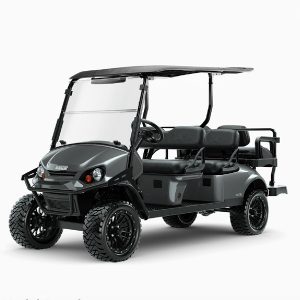
EZGO’s Liberty LSV ships from the factory with every required piece of street-legal equipment already installed.
The Liberty includes DOT-approved headlamps, automotive-grade tail lamps and brake lights, turn signals, three-point seatbelts, a DOT-compliantwindshield, mirrors, a horn, and a parking brake.
The Liberty also comes with a factory-assigned 17-digit VIN and a Manufacturer’s Certificate of Origin (MCO) for straightforward DMV registration.
Learn more in our EZGO Liberty: Street Legal Golf Cart guide.

How Do You Make a Golf Cart Street Legal?
Carts & Parts has completed hundreds of street-legal golf cart conversions for customers across Indiana and Ohio since 2007.
Our certified EZGO technicians assess your cart’s current condition, identify exactly which equipment your state requires, and handle the full installation.
We back every conversion with our reputation, built on more than 1,550 five-star reviews and a near-perfect rating.
When Jessica goings needed help getting her father’s cart road-ready, she found exactly the service she was looking for:
“Jeff helped my father get the golf cart he loved and made it completely street legal he was very satisfied with the customer service and said thank you yall did a wonderful job”
What Are the Steps to Make a Golf Cart Street Legal?
Converting a golf cart to street legal status follows a clear process. EZGO TXT, RXV, and Valor models offer the strongest platforms for conversion due to their reinforced frames and the availability of OEM accessories.
- Research your state and local regulations by contacting your DMV or municipal government to confirm required equipment and registration procedures.
- Decide whether to convert your current cart or purchase a factory LSV, such as the EZGO Liberty.
- Install all required safety equipment, including DOT-approved lighting, seat belts, mirrors, windshield, horn, and parking brake.
- Title, register, insure, and obtain a license plate for your cart through your state’s DMV.
For help choosing the right EZGO model, review our EZGO Golf Cart: 2025 Models & Buyer’s Guide.

What Equipment Does a Street Legal Golf Cart Need?
FMVSS No. 500, published by the NHTSA, lists the exact equipment every LSV must carry. The full federal standard is available at 49 CFR 571.500 on the Electronic Code of Federal Regulations.
Required federal equipment for any street-legal golf cart classified as an LSV:
- Headlamps meeting FMVSS No. 108 requirements.
- Tail lamps are visible from the rear during day and night operation.
- Stop lamps (brake lights) that activate when the brake pedal is engaged.
- Front and rear turn signal lamps flashing at 60 to 120 flashes per minute.
- Reflex reflectors on the front, rear, and both sides.
- A DOT-approved windshield with AS-1 or AS-4 glazing meeting FMVSS No. 205.
- An exterior rearview mirror meeting FMVSS No. 111 rear visibility requirements.
- A parking brake capable of holding the vehicle on a grade.
- Seat belt assemblies at every designated seating position per FMVSS No. 209.
- A horn or audible warning device.
- A 17-digit Vehicle Identification Number (VIN).
Many states add requirements beyond the federal minimum. Common additional items include DOT-approved tires, a slow-moving vehicle emblem, and side mirrors.
When John Frantz needed his cart lifted and converted, he experienced how quickly professional service delivers results:
“Great company to deal with. Very knowledgeable on all the aftermarket out there for my cart and they got it lifted and street legal in 3 days. I’m extremely satisfied”
For more on operating your cart on public roads, see Can You Drive a Golf Cart on the Road.
Who Can Drive a Street-Legal Golf Cart and Where Can It Be Used?
Driving a street-legal golf cart on public roads carries the same responsibilities as operating any registered motor vehicle.
Speed limits, right-of-way rules, and traffic signals all apply.

Do You Need a Driver’s License to Operate a Street-Legal Golf Cart?
A valid driver’s license is required in nearly every state to operate an LSV on public roads.
Most states set the minimum age for a standard license at 16 years old.
For a complete breakdown of age requirements, read How Old Do You Have to Be to Drive a Golf Cart.
Which Roads Can a Street-Legal Golf Cart Legally Use?
Federal law does not specify road restrictions for LSVs, leaving those decisions to state and local governments.
The most common standard allows LSV operation on roads with posted speed limits of 35 mph or lower.
All 50 states prohibit golf cart and LSV operation on highways and interstates. Many municipalities designate specific cart-friendly routes and create dedicated cart lanes.
Neighborhoods across the country are redesigning infrastructure to accommodate golf cart traffic.
Learn how communities are adapting in Why Customized Golf Carts Are Becoming the Must-Have Neighborhood Vehicle.

How Much Does It Cost to Make a Golf Cart Street Legal?
Professional street-legal golf cart conversion costs depend on your cart’s current condition and your state’s specific requirements.
Most owners spend between $800 and $2,500 for a complete conversion from a qualified installer.
Basic conversion packages typically include a headlight and taillight kit with turn signals, a rearview mirror, a horn, seat belts, and reflectors.
Premium packages add a DOT-approved windshield, upgraded disc brakes, side mirrors, and DOT-rated radial tires.
The most cost-effective option for many buyers is to purchase a factory-equipped LSV.
The EZGO Liberty ships with every required component installed, a 17-digit VIN, and an MCO for straightforward DMV registration.
Can You Drive a Street Legal Golf Cart on the Highway?
No state allows golf carts or LSVs on highways, interstates, freeways, or any road classified as a limited-access highway.
Federal classification of LSVs with a maximum speed of 25 mph makes highway operation both illegal and dangerous.
Some states allow LSVs to cross a highway at a controlled intersection, provided the crossing is made at a right angle and completed as quickly and safely as possible.
Check your state’s crossing rules before planning routes that intersect with higher-speed roads.
Cart-friendly communities often address crossing issues by installing dedicated golf cart underpasses and signalized crossings.
Read more in The Rise of Cart-Friendly Neighborhoods.
Is Insurance Required for a Street-Legal Golf Cart?
Yes, in most states. Any golf cart registered as an LSV must carry liability insurance similar to a standard automobile.
Requirements vary, but most jurisdictions mandate minimum coverage for Personal Injury Protection (PIP) and Property Damage Liability (PDL).
LSV insurance premiums are significantly lower than standard automobile insurance.
Most owners pay between $100 and $300 per year for adequate coverage.
Homeowner’s insurance policies rarely cover golf carts operated on public roads. A separate LSV or golf cart policy is almost always required.
Driving an unregistered, uninsured cart exposes you to financial liability that far exceeds the cost of a basic policy.
What Happens If You Drive a Golf Cart Without Street Legal Equipment?

Operating a non-compliant golf cart on public roads carries real legal and financial consequences.
- Fines and citations from local law enforcement range from $50 to $500 or more, depending on the number of violations.
- Vehicle impoundment is common in jurisdictions with strict enforcement. Retrieval fees and storage costs add up quickly.
- Voided insurance coverage applies if an accident occurs while driving an unregistered, non-compliant cart.
- Personal liability for injuries or property damage rests entirely with the operator when registration and insurance are not in place.
What Does Owning a Street Legal Golf Cart Look Like?
Owners who complete the conversion process correctly enjoy a new level of daily convenience and freedom.
- Running errands and visiting neighbors without starting the car or burning fuel.
- Saving hundreds of dollars annually on fuel, insurance, and maintenance compared to a second automobile.
- Driving with complete confidence that your cart meets every federal and state requirement.
- Joining a growing nationwide community of LSV owners who use their carts as primary short-distance transportation.
Mary Adair discovered how smooth the process can be when she visited Carts & Parts:
“I decided this year I was going to get a golf cart. Went to Carts & Parts, he showed me some with in my price range and I chose the yellow one that is now Bumblebee. Super friendly, answered all my questions, did the financing there, highly recommend if looking for a golf cart. Need to have it street legal so still at Carts & Parts for that but can’t wait to get. Thank you Carts & Parts!”
Get Professional Street Legal Golf Cart Service
Carts & Parts is East Central Indiana and Western Ohio’s exclusive EZGO dealership, trusted by more than 1,550 customers and rated near-perfect in reviews.
Our technicians install street-legal equipment, handle VIN documentation, and guide you through the registration process.
We offer street-legal conversion packages, factory-equipped EZGO Liberty LSVs, and flexible financing options that make road-ready ownership affordable.
Call (937) 459-8891 today to schedule your free, street-legal assessment.
Frequently Asked Questions About Street-Legal Golf Carts