How Does the EZGO Brake System Work?
The EZGO mechanical drum brake system uses steel cables to transfer force from the brake pedal to rear-mounted brake assemblies, which contain shoes that press outward against rotating drums.
Every EZGO cart from the Marathon through current Valor models relies on this proven design for reliable stopping power.
Understanding how each component functions helps owners diagnose problems early and select the correct replacement parts.
What Components Make Up an EZGO Drum Brake Assembly?
The brake drum assembly contains multiple precision components that work together during every stop.
Brake shoes with friction lining press outward against the inner drum surface when cables pull the actuating lever. Return springs pull the shoes back to their resting position when the pedal is released.
Self-adjusting mechanisms on 1994 and newer TXT models use a star wheel adjuster that automatically compensates for shoe wear.
Older Marathon models require manual adjustment through a square shaft accessible under a rubber cover on the backing plate.
The backing plate mounts to the rear axle housing and provides the anchor point for all brake components.
Wheel cylinders or mechanical levers (depending on model year) convert cable pull into the outward shoe movement that creates friction.

Brake drums bolt directly to the wheel hub and rotate with the tire.
The drum’s inner machined surface must remain smooth and round to ensure even contact with the brake shoes.
Drums that develop grooves, scoring, or out-of-round conditions require replacement, not resurfacing.
Mechanical EZGO Brakes vs RXV IntelliBrake Systems
Traditional mechanical drum brakes on TXT, Marathon, Medalist, and gas-powered models use physical cable connections throughout the system.
The driver’s foot pressure travels through the brake pedal, compensator assembly, brake cables, and finally to the brake shoes.
IntelliBrake technology on electric RXV models adds electronic motor braking that supplements the mechanical system.
The AC drive motor reverses polarity during deceleration, creating resistance that slows the cart while generating electricity for battery recharging.
The OEM EZGO Motor Brake for RXV models (PN# 10022890) provides the electronic braking function that enables IntelliBrake.
Failure of this component results in loss of regenerative braking and automatic hill holding.
Why Choose Carts & Parts for OEM EZGO Brake Parts

Carts & Parts stocks genuine OEM EZGO brake components with direct authorization from Textron for parts distribution.
Every brake shoe, drum, cable, and pedal assembly carries the same part numbers found in official EZGO service documentation.
More than 1,550 verified customer reviews with near-perfect ratings demonstrate consistent quality and service.
The company ships brake parts nationwide with free delivery on orders exceeding $50.
When Jeremy Romero needed brake components for his EZGO, the ordering experience exceeded expectations:
“Ordered an OEM EZgo brake and complete wiring harness. Great prices and fast shipping! Would recommend for any of your cart parts needs.”
The Complete EZGO Golf Cart Parts Guide provides detailed information on every component category, from electrical systems to suspension parts.
Brake components represent just one segment of the comprehensive OEM inventory available for TXT, RXV, Marathon, and Valor models.
Technical support staff answer brake system questions before purchase, ensuring customers receive the correct parts for their specific model year and configuration.
EZGO Brake Maintenance Plan for Long-Term Stopping Power
Consistent brake inspection prevents small problems from becoming expensive repairs.
The following schedule keeps EZGO stopping systems in peak condition:
- Inspect brake components every 6 months. Remove rear wheels annually to check shoe thickness, drum condition, and spring tension. Look for cracks, glazing, or contamination on friction surfaces.
- Check brake cable tension monthly. Press the brake pedal and note how far it travels before resistance begins. Increasing free play indicates cable stretch or adjuster issues.
- Replace brake shoes at the first sign of wear. Waiting until shoes wear completely damages drums and increases repair costs. Budget for shoe replacement every 3 to 5 years under normal use.
- Test the parking brake function weekly. Park on a slight incline and verify the cart holds position. The parking brake should engage with firm pedal pressure and release smoothly when the accelerator is activated.


What Are the Different Types of EZGO Brake Parts?
EZGO brake components are divided into wear items that require periodic replacement and structural parts that last the life of the cart under normal conditions.
Understanding which category each part falls into helps owners budget for maintenance and recognize when problems indicate deeper issues.
Wear items include brake shoes, brake drums (eventually), and brake cables. Structural components include backing plates, brake pedal assemblies, and compensator housings.
What Should You Know About EZGO Brake Shoes?
EZGO brake shoes create the friction that stops your cart. The curved metal shoe holds a bonded friction lining that presses against the brake drum’s inner surface.
As the lining wears, stopping power decreases until metal-to-metal contact damages the drum.
Genuine EZGO brake shoes (PN# 648037) feature friction material specifically formulated for golf cart operating speeds and loads.
According to EZGO technical documentation, brake shoes cannot be mixed between the current part number and older PN# 70795G01 shoes on the same axle.
How Many Brake Shoes Does an EZGO Cart Need?
Each EZGO brake drum has two brake shoes, so a complete axle replacement requires four brake drums.
The leading shoe (facing forward) typically wears faster than the trailing shoe because of the drum’s rotation during forward braking.
The EZGO Suspension and Steering Parts Guide covers related components that affect braking performance, including wheel bearings and axle assemblies.
How Do EZGO Brake Drums Affect Stopping Power?
EZGO brake drums provide the rotating surface that brake shoes press against to create stopping friction.
Cast-iron construction dissipates heat effectively, but drums eventually wear beyond safe tolerances due to repeated brake-shoe contact.
The OEM EZGO Brake Drum Assembly for gas models (PN# 21807G2) fits 2000 through 2025 production years and maintains factory specifications for proper brake function.
Electric model drums (PN# 19186G1P) use different spline patterns that match electric rear axle configurations.
Drum wear appears as grooves, ridges, or a lip at the outer edge where shoes contact the surface.
Unlike automotive drums that can be machined, golf cart drums lack sufficient material thickness for resurfacing. Worn drums require complete replacement.
Symptoms of drum problems include:
- Pulsating brake pedal feel during stops.
- Squealing or grinding noise even with new shoes.
- Cart pulling to one side during braking.
- Visible scoring or blue discoloration from overheating.

Hub splines on the drum must match the rear axle shaft splines tightly.
Loose fit causes clicking sounds and uneven braking.
When replacing drums, inspect the hub assembly for wear that might prevent proper seating.
How Do EZGO Brake Cables Work?
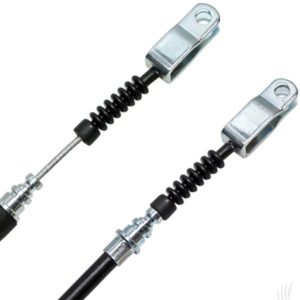
EZGO brake cables transmit force from the brake pedal to the rear brake assemblies through flexible steel cables housed in protective outer sleeves.
The cable system includes a compensator that balances the force between the left and right brakes, along with individual cables running to each wheel.
Cable stretch, corrosion, and binding represent the most common failure modes that affect braking performance.
Kevin Belknap describes the typical parts ordering experience at Carts & Parts:
“Fantastic transaction. They answered questions about my part order, shipped quickly, and kept me updated along the way. Will definitely order any parts from them in the future.”
What Brake Cable Lengths Fit Your EZGO Model?
Different EZGO models require specific cable lengths based on wheelbase and routing.
Installing cables of the wrong length results in either insufficient brake engagement or cables that bind and prevent full release.
The OEM EZGO Brake Cable Assembly comes in multiple lengths:
- 37.06 inches (PN# 624690): Driver side, TXT models
- 52.81 inches (PN# 624703): Extended routing applications
- 65.06 inches (PN# 624695): Passenger side, longer wheelbase
RXV models use different cable specifications:
- 44.5 inches (PN# CBL-070): Driver side, 2008-2020 gas RXV
- 65 inches (PN# CBL-071): Passenger side, 2008-2020 gas RXV
The EZGO Battery & Electrical Parts Guide covers related wiring that may run alongside brake cables, helping owners plan routing during replacement.
What are the signs of EZGO brake cable failure?
Brake cable failure begins with subtle symptoms that worsen over time. A spongy brake pedal that travels further than normal indicates cable stretch.
The pedal may feel firm initially, then gradually sink under sustained pressure as stretched cables allow it to move.
Cables that stick or bind inside their housings cause brakes to drag after release. You may notice the cart rolling harder than usual or brake components running hot after short trips.
Corroded cables often bind in one direction, engaging properly but failing to release completely.
Warning signs requiring immediate cable inspection:
- Brake pedal travels more than 1 1/8 inches before engagement.
- Parking brake fails to hold on inclines.
- Visible fraying or rust at cable ends.
- One wheel brakes harder than the other.
- Grinding sensation when pressing the brake pedal.
Replace cables in pairs (both sides) to ensure balanced braking. Mismatched cable condition causes pulling and uneven wear.
What Is EZGO IntelliBrake Technology?
EZGO IntelliBrake represents the most advanced braking system available on golf carts, combining electronic motor braking with traditional mechanical brakes on electric RXV models.
The technology eliminates common brake maintenance issues while adding safety features not possible with mechanical-only systems.
IntelliBrake debuted on the 2008 RXV platform and remains available on current production models.
The system requires specific motor and controller components that differ from those of TXT and other EZGO models.
Three primary functions define IntelliBrake operation:
- Automatic Parking Brake: When the cart stops moving, IntelliBrake automatically engages the parking brake without driver input. The system releases when the accelerator pedal is activated, eliminating forgotten parking brake situations that cause rollaway accidents.
- Regenerative Motor Braking: During deceleration, the AC drive motor reverses its direction to act as a generator. Resistance from electrical generation slows the cart while simultaneously charging the battery pack. EZGO documentation indicates 15% greater efficiency compared to DC-powered carts without regenerative braking.
Hill Holding: On grades, IntelliBrake applies motor resistance to prevent rollback without using mechanical brakes. The feature reduces brake shoe wear significantly on hilly terrain.

The National Highway Traffic Safety Administration (NHTSA) provides vehicle safety standards that influence golf cart brake system design, including requirements for parking brake holding capacity on grades.
How Does Regenerative Braking Extend Battery Life?
Regenerative braking captures kinetic energy that traditional brakes convert to waste heat.
When an IntelliBrake-equipped RXV decelerates, the motor acts as a generator, converting forward momentum into electrical current that flows back into the battery pack.
The energy recovery provides measurable benefits:
- Batteries retain 21% more energy than non-regenerative systems.
- Extended range per charge, especially on routes with frequent stops.
- Reduced brake shoe wear from decreased reliance on mechanical friction.
- Consistent speed control on downhill grades without brake fade.
EZGO rates IntelliBrake-equipped carts for approximately 180 additional rounds of battery life compared to standard configurations.
The motor brake component (PN# 10022890) must be replaced if the regenerative function fails while the mechanical brakes remain operational.
How Do You Replace EZGO Brake Pedal Assemblies?
EZGO brake pedal assemblies connect the driver’s foot pressure to the brake cable system through a series of levers, springs, and pivot points.
Wear in these components causes a spongy pedal feel, slow return, and inconsistent braking force even when cables and shoes remain in good condition.
Several OEM brake pedal assemblies serve different EZGO configurations:
- PN# 70690G02: Brake pedal assembly with brake light switch, TXT models
- PN# 70612G02: Brake pedal assembly without brake light switch
- PN# 671888: RXV brake pedal assembly
Replacing the pedal assembly requires removing the floor panel to access the mounting hardware and cable connections.
Which Brake Pedal Assembly Fits Your Cart?
The brake light switch determines which assembly your cart requires.
Street-legal configurations with lighting packages need the switched version (PN# 70690G02) to activate brake lights during pedal application.

The EZGO Engine & Fuel Parts Guide covers gas model components that interact with the brake system, including the kick-off cam that releases the parking brake when the accelerator is engaged.
Pedal return spring tension affects brake feel significantly. The torsion spring wraps around the pedal pivot and frame, pulling the pedal back to its rest position after release. Weak or broken springs cause slow pedal return and potential brake drag.
How Do You Adjust EZGO Golf Cart Brakes?
EZGO brake adjustment maintains proper shoe-to-drum clearance as friction material wears.
Most 1994 and newer models feature self-adjusting mechanisms that advance automatically during reverse braking. Older models and worn self-adjusters on carts require manual adjustment.
The self-adjusting system uses a star wheel mechanism inside each brake drum.
During reverse braking, a lever contacts the star wheel and advances it one notch, pushing brake shoes slightly closer to the drum surface. The process compensates for gradual shoe wear without requiring owner intervention.
Manual brake adjustment for older EZGO models:
- Locate the rubber cover on top of the backing plate.
- Remove the cover to access the square adjustment shaft.
- Turn the shaft clockwise to move the shoes outward toward the drum.
- Adjust until slight resistance occurs, then back off two clicks.
- Repeat on the opposite wheel for balanced braking.
Cable adjustment at the compensator assembly fine-tunes overall system tension. Loosen the lock nut and rotate the spherical adjustment nut to increase or decrease cable tension.
The Consumer Product Safety Commission (CPSC) recommends regular brake inspection on all low-speed vehicles to prevent accidents.
Why Do EZGO Brakes Squeal or Grind?
Brake noise indicates contact between components that should not touch or contamination affecting friction surfaces.
Squealing and grinding require different diagnostic approaches based on when the noise occurs and how it sounds.
High-pitched squealing during light braking often results from glazed brake shoe surfaces. The friction material develops a hardened, shiny layer that vibrates against the drum.
Light sanding with medium-grit sandpaper removes glazing and restores proper friction.
Grinding noise during any braking indicates metal-to-metal contact. Brake shoes have worn through their friction lining, and the metal backing plate now contacts the drum directly. Continued operation damages drums beyond repair.
Other noise causes include:
- Dust and debris between shoes and drums create intermittent scraping.
- Loose backing plate hardware allows components to shift and contact.
- Worn return springs fail to fully retract the shoes, causing drag.
- Contaminated friction surfaces from oil, grease, or brake fluid.
How Do You Stop EZGO Brakes from Squeaking?
Eliminating brake squeal requires identifying the specific cause.
For glazed shoes, remove the drums and scuff the friction surface with 80-grit sandpaper in a cross-hatch pattern. Clean thoroughly with brake cleaner before reassembly.
An anti-squeal compound applied to the back of brake shoes dampens vibration that causes noise. Apply only to the metal backing plate, never to friction surfaces.
Bent backing plates allow drums to run off-center, creating intermittent contact that squeals. Check plate flatness with a straightedge and replace if warped.
| BRAKE NOISE DIAGNOSTIC GUIDE | ||||
|---|---|---|---|---|
| Severity | Noise Type | When It Occurs | Likely Cause | Solution |
| Minor | High-pitched squeal | Light braking | Glazed brake shoes | Scuff with 80-grit sandpaper |
| URGENT | Metal grinding | Any braking | Shoes worn to metal | Replace shoes immediately |
| Minor | Intermittent scraping | Random | Debris in the drum | Clean with brake cleaner |
| Service Soon | Clicking or tapping | During braking | Loose hardware | Tighten all mounting hardware |
| Service Soon | Pulsating pedal | Steady braking | Warped drum | Replace brake drums |
How Long Do EZGO Brake Parts Last?
EZGO brake component lifespan varies based on usage patterns, terrain, load, and maintenance practices.
Understanding typical replacement intervals helps owners budget for parts and recognize premature wear that indicates underlying problems.
Expected service life for common brake components:
- Brake shoes: 3 to 5 years or 10,000 to 15,000 miles under normal use
- Brake drums: 8 to 12 years with proper shoe maintenance
- Brake cables: 5 to 8 years before stretching requires replacement
- Brake pedal assembly: 10+ years with spring replacement as needed
- Return springs: Replace with every shoe change
Heavy loads, hilly terrain, and frequent stopping accelerate wear significantly. Carts used for hauling or in mountainous communities may require shoe replacement every 1 to 2 years.
The EZGO Controls & Switches Guide covers related components, such as the forward/reverse switch, which affects brake system operation via the kick-off cam linkage.
What Safety Equipment Complements EZGO Brakes?
Golf cart safety extends beyond the brake system to include lighting, mirrors, and occupant protection.
Complete stopping ability means little if other drivers cannot see the cart or if passengers lack secure seating.
Essential safety equipment for EZGO carts:
- Headlights and taillights for visibility during low-light operation
- Brake lights that activate when the brake pedal engages
- Turn signals for communicating direction changes
- Rearview mirrors showing traffic approaching from behind
- Seat belts on street-legal configurations
- Horn for audible warning capability
The Occupational Safety and Health Administration (OSHA) provides workplace safety guidelines for golf carts used in commercial and industrial settings.
Brake inspection forms part of the required pre-operation checks.
Brake light switches integrate with the pedal assembly to illuminate rear lights during braking.
The switch version of the brake pedal assembly (PN# 70690G02) includes this functionality for carts with installed lighting packages.
What Happens When EZGO Brakes Are Neglected?
Ignoring brake maintenance creates compounding problems that escalate repair costs and compromise safety.
Small issues that require inexpensive parts can escalate into major repairs affecting multiple components.
Consequences of deferred brake maintenance:
- Increased stopping distance increases the risk of collisions with obstacles, pedestrians, and other vehicles. Worn shoes that add just 10 feet to stopping distance at 15 mph can mean the difference between a close call and an accident.
- Worn shoes damage brake drums permanently when the friction material wears through to the metal backing plate. Drum replacement costs several times as much as preventive shoe replacement.
- Stretched cables cause inconsistent pedal feel, making it difficult to judge braking force. Drivers may over-brake in some situations and under-brake in others.
- Failed parking brakes allow rollaway accidents that injure people and damage property. Carts parked on even slight inclines can roll into traffic, buildings, or water hazards.
- Contaminated brake components from leaking seals or improper lubrication require complete system cleaning or replacement rather than simple part swaps.
- Heat damage from dragging brakes warps drums and hardens friction material, requiring replacement of parts that should have lasted years longer.
The financial impact of neglect multiplies. A $30 brake shoe set becomes a $200 drum-and-shoe replacement.
Continued neglect may lead to cable replacement, a pedal assembly rebuild, and potentially axle bearing damage from heat transfer.
What Does Proper EZGO Brake Function Look Like?
Well-maintained brakes provide predictable, confident stopping that owners often take for granted until problems develop. Knowing what good brakes feel like helps identify issues early.
Signs of properly functioning EZGO brakes:
- Firm, consistent pedal feel with engagement beginning within the first inch of travel
- Smooth, straight stops without pulling to either side
- Quiet operation with no squealing, grinding, or scraping
- Quick pedal return when foot pressure releases
- Secure parking brake hold on moderate grades without adjustment
Kevin Heaney experienced the difference professional service makes when his EZGO needed attention:
“Outstanding Service today. I had an electrical issue with my three year old EZGO Gas Cart. Starting with my purchase from Jeff three years ago to both Cole and Cade taking care of my problem today. Called and talked to Cole yesterday. He said to bring it by today and wait on it. Should only take about 60 Minutes. He thought it could be one of three things. I live 90 minutes away and thought it would require two trips. Arrived at 10:00 am and left at 11:00 am. Problem taken car of along with a tuneup and service. Fantastic customer service from a Family that cares. Thank You Jeff, Cole and Cade. I will share your company with everyone I come across looking for a cart.”
Benefits of maintaining proper brake function:
- Peace of mind knowing the cart will stop when needed
- Extended component life from balanced, even wear
- Lower long-term ownership costs through preventive maintenance
- Safer operation for passengers and bystanders
- Better resale value when selling the cart
Get Professional EZGO Brake Parts
Carts & Parts provides genuine OEM EZGO brake components for every model from Marathon through current Valor production.
As an authorized EZGO dealer with more than 2,000 five-star reviews, the team delivers expert guidance on part selection and installation.
Transparent pricing, nationwide free shipping on orders over $50, and technical support before and after purchase set Carts & Parts apart from generic parts suppliers.
Call (937) 459-8891 to speak with brake system specialists who understand the differences between TXT, RXV, and Valor configurations. Get the right parts the first time and keep your EZGO stopping safely for years to come.
Browse the complete EZGO brake parts inventory online or visit the Union City, Indiana, showroom to see components in person.
Frequently Asked Questions About EZGO Golf Cart Brake Parts