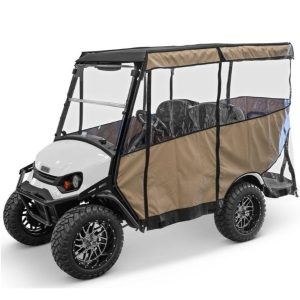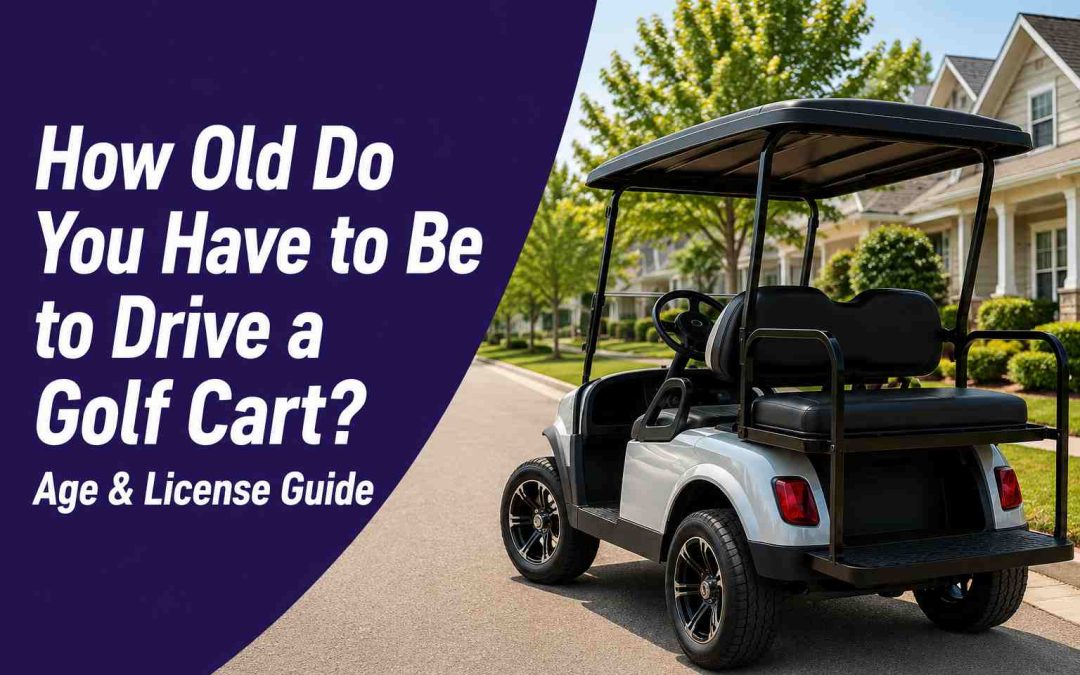
Knowing how old you have to be to drive a golf cart legally depends entirely on where you plan to operate it and what type of roads or property are involved. A parent lets their teenager take the cart around the neighborhood, not realizing the local ordinance requires a valid driver’s license on public paths.
Contents
ToggleA property owner hands the keys to a twelve-year-old on a private lot, completely unaware that state law draws a hard line even on private land in some jurisdictions. That moment of uncertainty can turn a relaxed afternoon into a liability problem.
Age rules for cart operation are not uniform. They shift based on whether you are on private property, a community road, or a public street with posted speed limits.
The three situations owners run into most often:
- Private property has no posted rule, so assumptions replace facts and the wrong person ends up behind the wheel.
- Neighborhood associations and planned communities set their own minimum age requirements that are stricter than state law.
- Street-legal carts operated on public roads fall under Low-Speed Vehicle regulations that require a licensed driver regardless of the cart’s speed.
Carts & Parts is an authorized E-Z-GO dealer serving East Central Indiana and Western Ohio with OEM parts, expert guidance, and more than 2,000 five-star reviews. If you are sorting out how old you have to be to drive a golf cart and what accessories make your cart safer and more ready for any rider, this guide covers every rule you need to know.
Key Takeways
How old do you have to be to drive a golf cart on private property?
Most states allow children as young as 13 to 14 years old to operate a golf cart on private property without a driver’s license, though there is no single federal minimum. States like Indiana permit minors to drive on private land under adult supervision, while some states impose no minimum age at all as long as the operation stays off public roads. Always verify your state’s specific statute before allowing a minor to operate any motorized vehicle.
What is the minimum age to drive a golf cart on a public road?
Driving a golf cart or Low-Speed Vehicle (LSV) on a public road in the United States generally requires the operator to be at least 16 years old and hold a valid driver’s license. Under NHTSA FMVSS 500, any vehicle classified as an LSV operating on roads posted at 35 mph or under must meet federal equipment standards and be driven by a licensed operator. Some states set the bar higher at 18.
Do you need a driver's license to operate a golf cart?
A driver’s license is not required for operation on private property in most states, but it is required for any public road use in virtually every jurisdiction. EZGO TXT and EZGO RXV carts that have been street-legal converted and registered as LSVs are subject to the same licensing rules as automobiles on public roads. Operating without a license on public streets can result in fines, impoundment, and liability exposure.
What safety equipment does a street-legal golf cart require?
A street-legal EZGO cart operating as an LSV must be equipped with headlights, tail lights, turn signals, mirrors, a windshield, seat belts, and a vehicle identification number (VIN) to comply with FMVSS 500 federal standards. Most states also require liability insurance and vehicle registration for any cart operated on public roads. Check your state’s DMV for any additional equipment requirements beyond the federal baseline.

What Is the Minimum Age to Drive a Golf Cart?
The minimum age to drive a golf cart differs sharply between private property and public road operation, and no single federal rule covers both. An EZGO TXT cruising a private residential lot operates under state law only, while the same EZGO RXV converted to street-legal status falls under NHTSA’s FMVSS 500 Low-Speed Vehicle standard the moment it touches a public road.
Private property gives states the most flexibility. Public roads take that flexibility away entirely.
How Old Do You Have to Be on Private Property?
Most states set the private property minimum between 13 and 16 years old, and several states impose no hard minimum at all for closed, private land. Indiana does not specify a hard statewide minimum age for private property operation, but operators must remain completely off public roads and public cart paths to avoid the licensing requirement. Ohio follows a similar framework — private property use is largely unregulated by age, but any contact with a public roadway triggers the standard vehicle operation laws.
Adult supervision is strongly recommended for any operator under 16 regardless of what state law technically allows. Cart weight, acceleration, and braking characteristics are meaningfully different from a bicycle, and inexperienced operators misjudge turning clearance and stopping distances regularly.
Does the Age Requirement Change for Neighborhood or Community Use?
Neighborhood and community use is where private property rules most often break down. Many planned communities, HOA-managed neighborhoods, resort properties, and multi-use developments post their own minimum age requirements that are stricter than state law. A community that allows cart traffic on internal roads typically requires operators to be at least 14 to 16 years old, and some require a valid driver’s license even on private community roads.
Check with your HOA, property management company, or community association before assuming state minimums apply. Posted rules on private community roads are legally enforceable by the property owner.
What Age Do You Need to Drive a Golf Cart on Public Roads?
Low-Speed Vehicles operated on public roads in the United States fall under NHTSA’s Federal Motor Vehicle Safety Standard 500, which establishes a top speed of 20 to 25 mph and mandates specific safety equipment for any vehicle in that class. The EZGO RXV and EZGO TXT can be configured as LSVs, but doing so subjects the cart and its operator to the same licensing age requirements as a standard automobile.
Most states require public road cart operators to be at least 16 years old with a valid driver’s license. Several states — including Florida, Georgia, and South Carolina, which have high cart traffic in residential communities — set 16 as the firm minimum and require the cart to be registered and insured.
For drivers in Indiana and Ohio, the rule is consistent: any motorized vehicle operated on a public road requires a licensed driver of at least 16 years of age. No exemption exists for low-speed vehicles or carts. Review the full street-legal golf cart requirements before modifying or registering your cart for road use.
What Is Considered a Street-Legal Golf Cart?
A cart qualifies as a Low-Speed Vehicle under NHTSA’s FMVSS 500 when it has a maximum speed between 20 and 25 mph and is equipped with headlights, rear combination lamps, turn signals, stop lamps, reflectors, a windshield, mirrors, seat belts, and a VIN. Standard EZGO TXT and EZGO RXV models from the factory do not include all of these components and require modification and registration to meet LSV status.
For a detailed breakdown of what your cart needs to qualify, the NHTSA Low-Speed Vehicle page lists every federal equipment requirement in plain language.
Which States Have the Lowest Minimum Age for Public Road Use?
Several states allow drivers as young as 14 to operate carts on designated low-speed roads with a learner’s permit, though full solo operation almost always requires a standard driver’s license at 16. No state allows unlicensed minors under 14 to operate a cart on any public road without adult supervision. State law changes frequently — always confirm with your state DMV before allowing a minor to drive on any public road.
Does a golf cart need to be registered to drive on public roads?
Yes. Any EZGO or other golf cart classified as a Low-Speed Vehicle and operated on a public road in Indiana, Ohio, or any other U.S. state must be registered with the state’s DMV and display a valid license plate. Unregistered carts operated on public roads are subject to the same fines and impoundment procedures as unlicensed automobiles.
Can a 15-year-old with a learner’s permit drive a golf cart on a public road?
In most states, a learner’s permit does not satisfy the licensing requirement for operating a cart on a public road independently. Some states allow a permitted driver to operate a cart on designated low-speed roads with a licensed adult in the vehicle, but unsupervised operation is not permitted until a full driver’s license is obtained at 16 or older.
Do You Need a Driver’s License to Drive a Golf Cart?
The license requirement follows the road type, not the vehicle type. No driver’s license is required for operating a cart on completely private property in the vast majority of states, including Indiana and Ohio. The moment the cart crosses onto any public roadway — including a public cart path that intersects a street — the standard motor vehicle licensing laws apply in full.
For EZGO RXV and EZGO TXT operators on private residential property, the practical takeaway is straightforward: keep the cart on your property or within a private community that authorizes cart traffic on its internal roads, and the licensing question disappears entirely.
For operators who want to travel beyond private property, the eCFR federal low-speed vehicle regulations provide the authoritative legal framework that every state builds on. Review golf cart safety regulations and practices to understand what equipment and operator requirements apply in your situation before taking your cart on any public road.
How Does Cart Safety Equipment Affect Who Can Drive?
Safety equipment does not change the legal age minimum, but it changes the real-world risk level for every operator, especially younger or newer drivers. An EZGO TXT or EZGO RXV without functioning lights, tight steering, and reliable drivetrain components is a hazard for any operator at any age.
What Safety Features Make a Golf Cart Safer for Younger Drivers?
Operational condition is the single biggest safety factor for younger drivers. Worn axle components, sloppy steering, and deteriorated brakes amplify every mistake a new operator makes. A cart that pulls, vibrates, or has loose handling is harder for experienced drivers to control — and significantly more dangerous for operators with limited experience.
Why Does Cart Maintenance Matter for Any Driver’s Safety?
Drivetrain integrity starts at the axle. The OEM EZGO Golf Cart Axle Shaft with Bearing (Driver Side) — Genuine E-Z-GO Part #639876 is a direct-fit replacement for EZGO TXT and EZGO RXV models that restores proper power transfer and eliminates the vibration and pulling that compromised axle components produce. Installing factory OEM components ensures the cart operates within its designed handling envelope, which matters most when a less experienced operator is in the seat.
Shop the OEM EZGO Golf Cart Axle Shaft with Bearing (Driver Side) — Part #639876 at Carts & Parts.
Adam Sweigart found exactly the kind of expertise he needed when he brought his cart in for service:
“Outstanding service and communication. The staff was knowledgeable about my cart and did not try to oversell or promote anything extra. The staff addressed exactly what they did and provided the reason why it was necessary. Timely service and will definitely use for future service and accessories.”
💡 Tip: Before allowing a new or younger driver to operate your cart, walk through the steering feel, brake response, and tire condition yourself first. A five-minute inspection catches the issues that matter most before someone else gets behind the wheel.
What Accessories Should Every Cart Owner Have Regardless of Age?
Accessories do not lower the driving age, but they make every ride more comfortable and every operator more prepared. The right combination of storage, protection, and electrical reliability keeps your EZGO in peak condition year-round.
How Does a Beverage Cooler Keep Rides Comfortable for the Whole Family?
Built-in beverage storage eliminates the loose containers and shifting cargo that distract drivers and cause spills. The OEM EZGO Golf Cart Beverage Cooler — Genuine E-Z-GO Part #658503 is a factory-designed accessory that mounts cleanly to EZGO TXT and EZGO RXV carts and keeps drinks secure during operation. The OEM fit means no drilling, no improvised mounts, and no rattle.
Shop the OEM EZGO Golf Cart Beverage Cooler — Part #658503 at Carts & Parts and pair it with the EZGO Cooler Kit for the complete factory-integrated setup.
What Does a Storage Cover Do Between Rides?
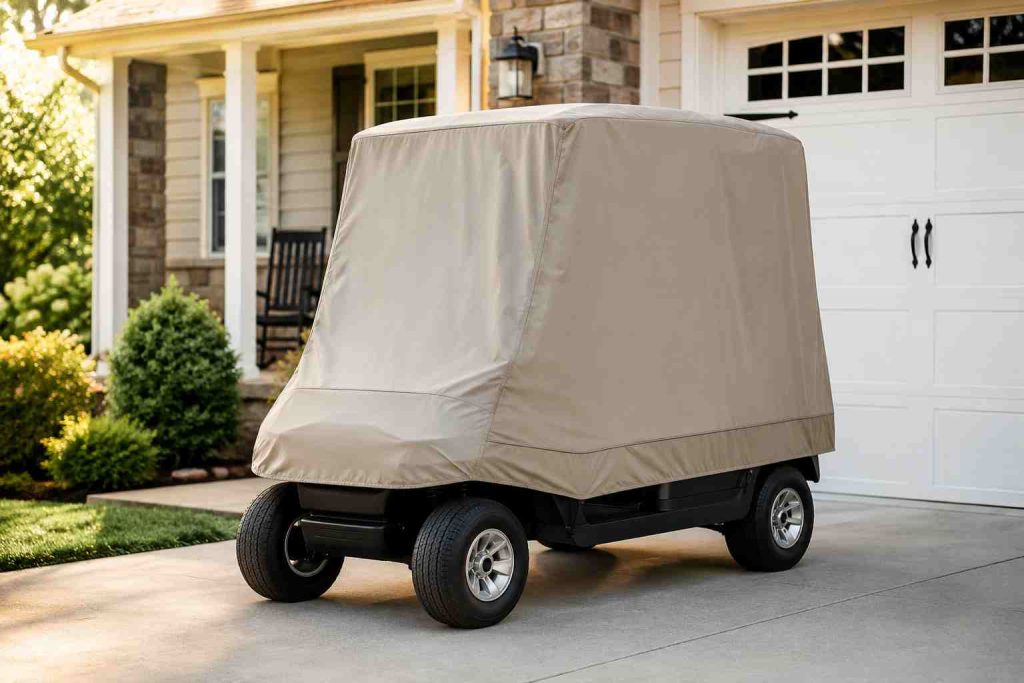
Protecting your cart between uses is just as important as maintaining it mechanically. The Pro-Fit Universal Golf Cart Storage Cover 4-Passenger 80″ Top — PN# PF12135 fits EZGO TXT, EZGO RXV, Club Car, and Yamaha 4-passenger carts with an 80-inch top and provides full weather protection from rain, sun, dust, and debris. UV-resistant material preserves the body and upholstery between uses.
Shop the Pro-Fit Universal Golf Cart Storage Cover 4-Passenger 80″ Top — PN# PF12135 at Carts & Parts.
Barb Cordonnier knows what the right cover does for everyday cart life:
“Thanks to Carts & Parts for getting a cover for our new golf cart. Now we can stay dry and warm at softball and baseball games. Thanks Jeff.”
Which Storage Cover Fits a Standard 4-Passenger Cart?
For owners looking for a universal-fit option at a lower price point, the Storage Cover 4-Passenger — SKU GC-COVER4 fits EZGO, Club Car, and Yamaha 4-passenger models and delivers reliable protection between uses without requiring model-specific fitment. The cover slips on and off quickly and stores compactly.
Shop the Storage Cover 4-Passenger — SKU GC-COVER4 at Carts & Parts.
How Does the Cart’s Electrical System Affect Safe Operation?
A cart with electrical problems is less predictable and less safe for any driver. Voltage fluctuations, erratic acceleration, and inconsistent speed response are warning signs that the cart’s electrical components need attention before anyone, especially a newer driver, gets behind the wheel.
What Does a Voltage Regulator Do on an EZGO Gas Cart?
The voltage regulator on EZGO gas-powered carts controls the output from the starter-generator and protects the 12-volt accessory circuit from overcharge and voltage spikes. When the OEM EZGO Voltage Regulator — PN# 27739G01 fails, the cart may experience battery drain, flickering lights, or erratic charging behavior. Replacing it with the genuine OEM part restores stable voltage across all electrical circuits and eliminates the unpredictability a failing regulator introduces.
Shop the OEM EZGO Voltage Regulator — PN# 27739G01 at Carts & Parts.
⚠️ Important: A voltage regulator failure on a gas cart can damage the battery and connected accessories if left unaddressed. Symptoms include lights that flicker at idle, a battery that discharges between uses, and a starter-generator that runs hot. Replace with the OEM part for your specific model year.
When Should You Upgrade to an AC Controller Package?
EZGO RXV Electric carts from 2009 and newer that have experienced controller failure or are being upgraded for improved performance benefit significantly from the OEM EZGO Golf Cart Curtis AC Controller Package — RXV Electric 2009+ Conversion Kit — Genuine E-Z-GO Part #750479PKG. The Curtis AC controller delivers smoother acceleration, more consistent power delivery, and better regenerative braking response than older DC systems. For any operator, especially one who is learning to drive, a controller that responds predictably and brakes progressively is measurably safer than a worn or failing unit.
Shop the OEM EZGO Curtis AC Controller Package — Part #750479PKG at Carts & Parts.
What Happens If You Ignore Age and Safety Rules?
Allowing an underage operator on a public road or an improperly maintained cart in any setting creates layered risk that compounds quickly. The consequences are not limited to the moment of the incident.
- Legal liability transfers to the cart owner when a minor operates a cart on a public road without a license, regardless of whether the owner was present. Property damage and injury claims fall on the registered owner.
- Insurance coverage may be voided if a claim involves an unlicensed or underage operator in a situation that violates state law. Carriers review operator age and licensing status as part of every claim.
- Mechanical failures cause accidents on carts that have not been properly maintained. A worn axle shaft, a failing controller, or a slipping brake on a cart driven by an inexperienced operator eliminates the margin for error entirely.
- Community access can be revoked when operators violate HOA or neighborhood cart policies. Private communities that manage their own cart paths can prohibit a household from cart access for rule violations.
Review golf cart safety regulations and practices to ensure your cart meets every requirement before your next ride.
What are the fines for an underage driver caught on a public road in a golf cart?
Fines for underage unlicensed cart operation on public roads vary by state and municipality but typically range from $50 to $500 for a first offense. Repeat violations and incidents involving property damage or injury carry significantly higher penalties and can result in vehicle impoundment. In Indiana and Ohio, the operator’s guardian may also be cited under parental liability statutes.
Sarah Milli’s experience at Carts & Parts shows what responsible ownership looks like when you start with the right guidance:
“I was sent to Carts & Parts by my cousins who have purchased from them before. I couldn’t be happier with my trip to Union City! The people were so polite and easy to work with! They were very helpful and listened to exactly what I wanted!!”
What Does Responsible Cart Ownership Look Like?
Getting the age and safety rules right from the start protects every rider and every owner. Responsible ownership is straightforward when you build the habit early.
- Know the specific rules for your setting — private property, HOA roads, and public streets each have different requirements. Confirm the rules before the first ride, not after the first incident.
- Keep your cart in OEM condition — factory-spec components deliver predictable handling and reliable stopping power. Aftermarket substitutes often cut corners on the tolerances that make safe operation possible.
- Set household rules that exceed the legal minimum — the legal minimum age is a floor, not a recommendation. Experienced judgment, not just age, determines when a driver is truly ready for independent cart operation.
- Store and protect the cart properly — a covered, well-maintained cart is ready when you need it and keeps moisture, UV exposure, and debris from accelerating wear on electrical and mechanical components.
✅ Good to Know: Carts & Parts ships OEM EZGO parts to customers nationwide with free shipping on orders over $50. Whether you need a replacement axle, a controller upgrade, or a storage cover, every part ships directly from an authorized E-Z-GO dealer with factory-verified fitment.
What Does Responsible Cart Ownership Look Like?
Getting the age and safety rules right from the start protects every rider and every owner. Responsible ownership is straightforward when you build the habit early.
- Know the specific rules for your setting — private property, HOA roads, and public streets each have different requirements. Confirm the rules before the first ride, not after the first incident.
- Keep your cart in OEM condition — factory-spec components deliver predictable handling and reliable stopping power. Aftermarket substitutes often cut corners on the tolerances that make safe operation possible.
- Set household rules that exceed the legal minimum — the legal minimum age is a floor, not a recommendation. Experienced judgment, not just age, determines when a driver is truly ready for independent cart operation.
- Store and protect the cart properly — a covered, well-maintained cart is ready when you need it and keeps moisture, UV exposure, and debris from accelerating wear on electrical and mechanical components.
✅ Good to Know: Carts & Parts ships OEM EZGO parts to customers nationwide with free shipping on orders over $50. Whether you need a replacement axle, a controller upgrade, or a storage cover, every part ships directly from an authorized E-Z-GO dealer with factory-verified fitment.
Get Professional Golf Cart Age and Safety Guidance
Carts & Parts is East Central Indiana and Western Ohio’s authorized E-Z-GO dealer with more than 1,550 five-star reviews and a full catalog of OEM parts, accessories, and safety equipment. Whether you are outfitting a new cart for family use, upgrading an older EZGO RXV with a Curtis AC controller, or simply making sure your cart is road-ready before a younger driver takes the wheel, our team knows exactly what your cart needs.
Call (937) 459-8891 to speak with a specialist. Free shipping on orders over $50.00. BUILT RIGHT. RIGHT HERE.
Frquently Asked Questions About Golf Cart Age & License
How old do you have to be to drive a golf cart in Indiana?
Indiana does not set a hard statewide minimum age for private property cart operation. For any public road use, we require a valid driver’s license, which means you must be at least 16 years old in Indiana. HOA-managed communities may set their own minimum ages as low as 14 for internal road use — always check your community’s specific rules before allowing a minor to drive.
Can a 14-year-old drive a golf cart on a public road?
No. Driving any motorized vehicle, including a street-legal EZGO, on a public road in Indiana or Ohio requires a valid driver’s license. The minimum licensing age in both states is 16. A 14-year-old with a learner’s permit cannot operate a cart on a public road without a fully licensed adult in the vehicle.
Do golf cart drivers need insurance?
Insurance is required in both Indiana and Ohio for any cart registered as a Low-Speed Vehicle and operated on a public road. For carts used only on private property, insurance is not legally required but is strongly recommended. Standard homeowner’s policies may not cover cart-related liability, so a separate recreational vehicle policy is worth confirming with your provider.
What is the difference between a golf cart and a Low-Speed Vehicle?
A standard golf cart has no mandated top speed, no required safety equipment beyond basic operational components, and operates legally only on private property. A Low-Speed Vehicle under NHTSA FMVSS 500 has a maximum speed of 20 to 25 mph, meets federal safety equipment standards, and can be licensed for public road use on streets posted at 35 mph or below. Many EZGO TXT and EZGO RXV carts are converted to LSV status through equipment upgrades and state registration.
Can a 10-year-old drive a golf cart on private property?
Some states place no minimum age on private property operation, but no state recommends unsupervised cart operation for a 10-year-old. At that age, the child lacks the physical control, judgment, and reaction time that safe cart operation requires. Adult supervision is the appropriate standard for any operator under 14, regardless of what state law technically permits.
What safety equipment is required on a street-legal golf cart?
A street-legal cart registered as an LSV must carry headlights, tail lights, stop lamps, turn signals, front and rear reflectors, an exterior mirror, a windshield, seat belts, and a VIN under NHTSA FMVSS 500. State registration and liability insurance are also required for public road operation in Indiana and Ohio. Some municipalities add reflective tape, horn, or speed limiter requirements on top of the federal baseline.
Does E-Z-GO make carts suitable for younger drivers?
E-Z-GO produces the TXT, RXV, and Liberty models across a range of configurations including speed-limited settings that many owners use for younger or newer operators. The EZGO RXV with a Curtis AC controller package can be configured with governor adjustments to limit top speed and smooth out acceleration response, making it more manageable for a less experienced driver under adult supervision on private property.
How fast can a street-legal golf cart go?
A cart classified as a Low-Speed Vehicle under FMVSS 500 has a maximum governed speed of 25 mph. Standard factory EZGO TXT and EZGO RXV electric models typically top out between 12 and 20 mph before any speed controller adjustment. LSV registration requires the cart to fall within the 20 to 25 mph window — too fast and it exceeds LSV classification; too slow and it may not be approved for the road.
What happens if a minor is caught driving a golf cart on a public road without a license?
In Indiana and Ohio, an unlicensed minor caught operating a cart on a public road faces a citation under standard unregistered or unlicensed vehicle operation statutes. Fines typically range from $50 to $500. The cart may be impounded. The minor’s parent or legal guardian can be cited under parental liability laws if the cart was provided knowingly. The registered owner assumes civil liability for any damage or injury the minor causes.
What golf cart accessories improve safety for new or young drivers?
The accessories that make the biggest safety difference for new or younger drivers are reliable mechanical components — specifically, a properly functioning axle shaft, a well-tuned controller, and a cart that steers true without pulling. Beyond mechanical condition, proper storage with a quality cover protects the cart between uses and prevents the kind of weather-related deterioration that accelerates wear on steering and braking components. Start with an OEM EZGO Axle Shaft with Bearing — Part #639876 and a Storage Cover to protect your investment and keep every ride safe.