A club car solenoid guide starts with one fact: every DS and Precedent, gas or electric, stops moving the moment its solenoid quits closing the circuit.
You press the pedal and hear a single click with no motion.
Sometimes the cart lurches forward only after the third or fourth try.
A gas engine that never even cranks points at the same small cylinder under the seat.
Few breakdowns feel more unfair, because the part at fault costs less than almost anything else on the cart. Every pedal press pushes hundreds of amps through two small contacts that wear out on no posted schedule.
Three problems bring most owners to this page:
- The cart clicks but refuses to move.
- Movement comes and goes, usually on warm days or after long runs.
- Nobody can say which of the four common Club Car solenoids fits your serial number.
Carts & Parts stocks OEM matched solenoids for every Club Car voltage and ships them nationwide from Union City, Indiana. The rest of this club car solenoid guide covers how the part works, how to test it, and how to match PN# 1113, 1120, 1118, or 1117 to your cart.
Key Takeaways
What does a Club Car solenoid do?
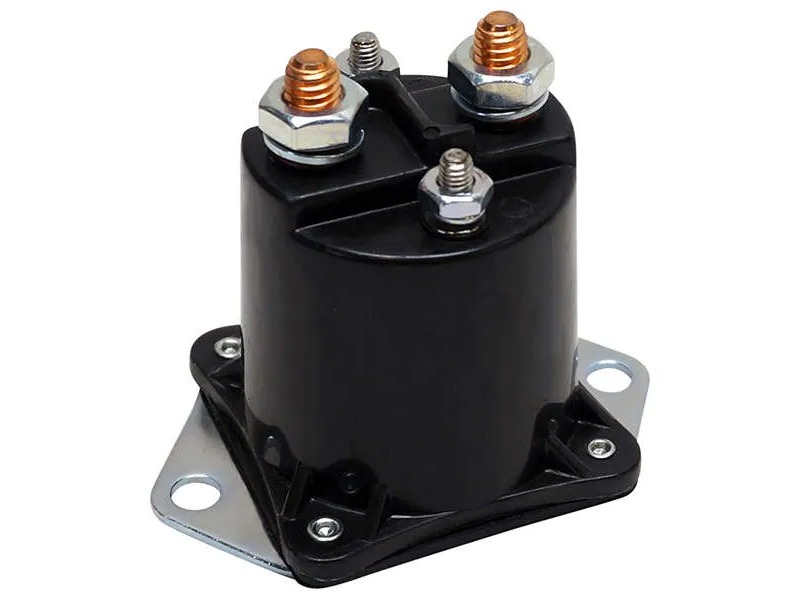
A Club Car solenoid works as the main power relay between the battery pack and the drive system on DS and Precedent models. A small signal from the key switch and pedal energizes an internal coil, which pulls two heavy contacts together and releases full pack current to the motor circuit. Electric carts use 36V or 48V solenoids, while gas models run a 12V unit off the starting battery.
How do you test a Club Car solenoid?
A Club Car solenoid tests with a digital multimeter in about fifteen minutes. Confirm battery voltage at one large post, press the pedal with the key on and forward selected, and check that voltage passes to the second large post when the unit clicks; a solenoid that clicks without passing current has burned contacts.
Which solenoid fits a Club Car DS?
Club Car DS electric models split by year and voltage: PN# 1113 covers 36V carts built 1976 to 1998, PN# 1120 covers 36V DS models 1997 and newer and replaces OEM number 1019759-01, and PN# 1118 covers 48V models from 1995 to 1997 with a 100 amp continuous rating.
What solenoid does a gas Club Car use?
Gas Club Car DS and Precedent models built 1984 and newer use the 12V solenoid sold as PN# 1117. The unit switches starter current from the starting battery rather than pack current, so it carries a different coil rating than the electric versions.
Other Notable Takeaways
- Standard Club Car solenoids carry 4 terminals: two small coil posts and two large current posts.
- Orders over $50.00 at Carts & Parts ship free anywhere in the country.
How Does a Club Car Solenoid Work?
The solenoid on a Club Car DS, Precedent, or PowerDrive system sits between the battery pack and the controller as an electromagnetic switch. Full pack current never touches your key switch or pedal; those controls only carry a small trigger signal, and the solenoid does the heavy lifting.
The coil inside the housing builds a magnetic field when the trigger signal arrives. The field pulls a plunger that presses a copper disc across the two large posts, and current flows from the pack through the disc to the controller and motor, which is the moment your cart moves.
Release the pedal and the field collapses. A spring pushes the disc off the posts and the circuit opens again. Our Club Car parts guide covers the surrounding electrical parts, belts, and cables if the solenoid checks out and the problem sits elsewhere.
Why Do 12V, 36V and 48V Carts Use Different Solenoids?
Coil voltage has to match the signal the cart sends, and contact ratings have to match the current the drivetrain pulls. A 36V coil wired into a 48V cart burns out early, while a 48V coil on a 36V system may never pull in at all.
PN# 1113, for example, carries copper contacts rated for 125 amps continuous with a 400 amp peak, sized for the draw of an electric motor under load. Gas carts flip the job entirely, since their 12V solenoid switches the starter for a second or two per start instead of feeding a drive motor continuously.
How Do You Pick the Correct Club Car Solenoid?
Picking the correct Club Car solenoid follows a fixed order: serial number first, voltage second, drivetrain third. The serial decal sits below the passenger side cup holder on the Precedent and newer DS carts, or above the accelerator pedal on older DS builds, and the official Club Car owner’s manual library sends the matching manual for that number.
Count your batteries next. Six 6V batteries mean a 36V cart, six 8V or four 12V batteries mean 48V, and a single automotive style battery on a gas cart means the 12V starter solenoid.
| Part Number | Voltage | Fits | Key Specs | OEM Cross Reference |
|---|---|---|---|---|
| 1113 | 36V | Electric Club Car, 1976 to 1998 | 4 terminals, copper contacts, 125 amp continuous, 400 amp peak | Call to confirm |
| 1120 | 36V | Club Car DS, 1997 and newer | 4 terminals | 1019759-01 |
| 1118 | 48V | Club Car models, 1995 to 1997 | 4 terminals, 100 amp continuous, 400 amp peak | 1018070-01 |
| 1117 | 12V | Gas Club Car DS and Precedent, 1984 and newer | Starter circuit solenoid | See product page |
Source: Carts & Parts live product listings. Confirm fitment by serial number before ordering.
Correct part verification is the step our counter team spends the most time on, and it shows in the more than 2,000 online reviews Carts & Parts has earned with a near perfect rating. Carlos Teran leaned on that help while sourcing parts for his new repair operation:
“I am establishing a Golf Cart repair and upgrades business, while I was looking for a source of golf cart parts online, I came across the most friendly Midwest staffs at “Cart & Parts,LLC now they are my future source, the promptnes was greatly appreciated. I was very impressed with the willingness to ensure I was getting the correct part and appropriate shipping, the customer service is true professionalism. It took no time before l new it the parts were shipped. One Fantastic experience! Thank you again for the prompt response, I will definitely purchased from C&P from now on and in the future. I highly recommend Cart & Parts, LLC for your golf cart needs.”
What Is Your Testing Plan?
Testing a Club Car solenoid takes four steps before you spend anything:
- Photograph the wiring, then disconnect the main negative cable at the battery pack.
- Reconnect, set your multimeter to DC volts, and verify pack voltage at the solenoid’s supply post.
- Have a helper press the pedal with the key on and forward selected while you listen for the click and measure the output post.
- Compare readings, since voltage in with no voltage out during the click means failed contacts.
How Do You Test a Club Car Solenoid With a Multimeter?
A multimeter reading on a Club Car solenoid separates a dead coil, burned contacts, and an upstream wiring fault in a few minutes, and each symptom points to a different cause.
Symptom: A single click with no movement.
Cause: The coil works, but burned or pitted contact discs block the current path.
What it means: The solenoid passed its trigger test and failed its power test, so replacement fixes it.
Symptom: No click at all.
Cause: The coil has opened internally, or the trigger signal never arrives.
What it means: Measure across the two small posts while a helper presses the pedal; signal present with no click condemns the coil, and no signal points upstream at the key switch, pedal switch, or forward and reverse selector.
Symptom: The cart runs, then cuts out when hot.
Cause: Heat expands worn contacts and breaks marginal connections.
What it means: Intermittent operation that improves after the cart cools almost always ends at the solenoid.
⚠️ Important: Disconnect the main negative battery cable before touching any solenoid terminal, and remove rings and metal watch bands first. OSHA’s guidance on battery charging precautions under 29 CFR 1910.178(g) exists because pack short circuits arc violently enough to weld tools to terminals.
Can you test a Club Car solenoid without removing it?
A Club Car solenoid can be tested without removing it, since every multimeter check above happens with the solenoid mounted in place. Removal only becomes necessary at replacement time.
What reading should a Club Car solenoid coil show?
A healthy Club Car solenoid coil shows continuity with measurable resistance across the two small posts. An open circuit reading means the winding has failed internally and the solenoid needs replacement.
Which 36V Solenoid Fits Your Club Car?
Two part numbers cover every 36V Club Car, and the model year decides between them. Both carry four terminals and mount in the same location, so the label matters more than the look.
The Club Car 36V solenoid for 1976 to 1998 models, PN# 1113 serves the long run of early electric carts. Copper contacts rated at 125 amps continuous with a 400 amp peak give it enough headroom for stock motors and mild upgrades alike.
💡 Tip: The two 36V part numbers overlap in 1997 and 1998. Pull your serial number before ordering a solenoid for either year, and call us with it if the decode leaves any doubt.
Newer 36V DS carts take the Club Car DS 36V solenoid for 1997 and newer models, PN# 1120, which replaces OEM number 1019759-01. Matching the year protects the new unit from an early failure.
What About 48V and Gas Club Car Models?
Mid 1990s 48V carts and every gas model since 1984 each get a dedicated part, and neither borrows from the 36V shelf. Voltage stamped on the old solenoid or counted across the battery bank removes the guesswork.
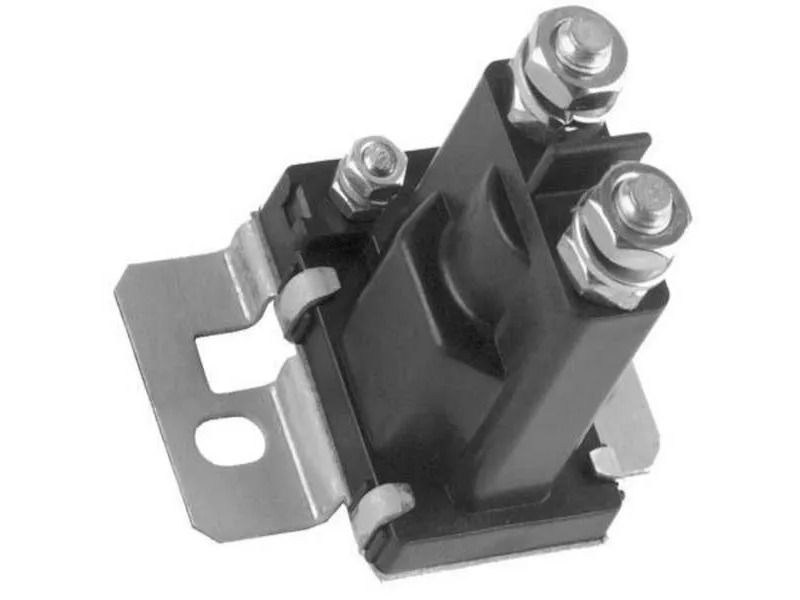
The Club Car 48V solenoid for all models 1995 to 1997, PN# 1118 carries four terminals, a 100 amp continuous rating with a 400 amp peak, and replaces OEM number 1018070-01. PowerDrive era carts in that window fall under it as well.
A failing solenoid on these carts sometimes gets misread as controller trouble, since both faults kill forward motion. Our golf cart controller guide shows how to separate the two before any parts money changes hands.
Which Solenoid Does a Gas Club Car Need?
Gas DS and Precedent carts built 1984 and newer run the Club Car DS and Precedent gas 12V solenoid, PN# 1117. The unit takes its trigger from the key circuit and switches the starter, so a dead solenoid here means an engine that never cranks rather than a cart that never rolls.
Swap time runs about the same as the electric versions: four wires and two mounting bolts.
A gas cart that cranks slowly rather than not at all usually has a weak starting battery or a loose cable rather than a failing solenoid. Check the battery voltage and both cable ends before ordering, since a fresh 1117 on a tired battery changes nothing.
What Are the Most Common Club Car Solenoid Problems?
Club Car solenoid problems on the DS and Precedent platforms come down to four repeat offenders: burned contacts, open coils, corroded terminals, and a failed resistor or diode across the large posts. Burned contacts lead the list by a wide margin because every pedal press arcs the discs a little.
Corrosion earns second place in any cart stored outdoors. Green or white crust on the posts raises resistance, which builds heat, which cooks the contacts faster, and a wire brush plus dielectric grease during battery maintenance stretches solenoid life considerably.
The small resistor bridging the large posts on many electric models deserves respect too. A burned resistor after a lithium conversion or controller swap signals a mismatch upstream rather than a defective solenoid, so fix the cause before installing the replacement.
Is a DS Solenoid Different From a Precedent Solenoid?
A DS solenoid and a Precedent solenoid interchange only when voltage, year range, and drivetrain all line up, and the gas side is where they overlap most. PN# 1117 covers gas versions of both platforms in one part, while electric carts stay year and voltage specific.
Compare the new part to the old one before wiring it in. The terminal layout and mounting bracket should match what came off the cart, and a solenoid that bolts down loosely lets vibration work the terminal nuts free within a season.
Owners running mixed fleets ask about crossover with other brands as well. E-Z-GO carts follow a completely different solenoid lineup by model and controller type, and our EZGO golf cart solenoid guide handles that side of the shop with the same test first approach.
✅ Good to Know: Every order over $50.00 ships free nationwide, and in stock solenoids ship fast from Indiana.
What Happens If You Keep Driving on a Failing Solenoid?
Every additional mile on pitted contacts raises the stakes on a Club Car past inconvenience, and marginal solenoids fail in predictable and expensive ways.
- Contacts can weld shut, leaving the cart powered and moving with no way to stop it electrically.
- Intermittent connections strand you at the far end of the property instead of in the shed.
- Resistance heat migrates into cables, terminals, and the controller connection.
- A stalled gas starter circuit invites repeated cranking that drains the starting battery flat.
What Does Success Look Like After Replacement?
A fresh solenoid changes the first second of every trip on a DS or Precedent: the pedal responds with one clean click and immediate motion, cold mornings and hot afternoons included.
- Instant, consistent takeoff with no repeat pedal presses.
- One firm click instead of chatter or buzzing.
- Cooler terminals and cables after long runs.
- A starter that spins the moment the key turns on gas models.
Brad Brannon summed up the ordering side of that outcome in a single line:
“Great service, part was shipped to me with a quickness!”
Get Professional Club Car Solenoid Help
Cart owners nationwide call Carts & Parts because a family run, authorized E-Z-GO dealer that also stocks and services Club Car and Yamaha models can talk fitment from experience rather than a screen. Give us your serial number and we will confirm the exact solenoid before anything ships.
Mark Smith kept his recommendation short:
“Best place to go for parts. Very knowledgeable Greatest customer service USE THEM”
Call (937) 459-8891 with your serial number and voltage, and the correct part heads your way the same day whenever possible.
Frequently Asked Questions About Club Car Solenoids
How do I know if my Club Car needs a 36V or 48V solenoid?
Count the batteries under the seat. Six 6V batteries add up to a 36V system, while six 8V or four 12V batteries make 48V. We can also confirm from your serial number when you call, since battery swaps over the years sometimes muddy the picture.
Why does my Club Car click but not move?
A click proves the coil works, so the failure sits in the contact discs that pass drive current. Test for voltage on the output post during the click, and replace the solenoid when nothing passes through.
Can I install a Club Car solenoid myself?
Most owners handle the swap with basic hand tools in under an hour. Disconnect the batteries, photograph the wiring, move four wires to the new unit, and bolt it down. We answer installation questions by phone if anything on your cart looks different from the old part.
What does the small resistor on the solenoid do?
The resistor across the large posts precharges the controller’s capacitors before the contacts close, which prevents a damaging inrush spike. A burned resistor usually points to a controller or battery mismatch, so resolve the upstream cause along with the solenoid.
How long does a Club Car solenoid last?
Lifespan tracks pedal presses more than years, since every engagement arcs the contacts slightly. Carts used for daily property work wear solenoids faster than weekend cruisers, and outdoor storage corrodes terminals and shortens the timeline.
Are Club Car solenoids interchangeable with EZGO or Yamaha parts?
No. Coil voltages, mounting patterns, and trigger circuits differ across brands, and forcing a near fit risks the controller. We stock brand specific solenoids for all three makes, so matching your cart exactly costs nothing extra.
Which solenoid fits a 1996 48V Club Car?
PN# 1118 covers 48V Club Car models from 1995 to 1997, including PowerDrive era carts, with a 100 amp continuous rating. The part replaces OEM number 1018070-01, and counting six 8V batteries confirms the 48V system before you order.
Do you ship Club Car solenoids nationwide?
Yes, we ship solenoids and every other part we stock across the country from Union City, Indiana. Orders over $50.00 ship free, and most in stock solenoids leave the building the same business day the order arrives.
Can a bad solenoid drain my batteries?
A solenoid with contacts welded partially closed can pull current at rest and bleed the pack down overnight. Corroded terminals also waste charge as heat during driving, and either condition shows up as shrinking range before the cart quits.
What if the new solenoid clicks but the cart still will not move?
Look upstream and downstream. Check the forward and reverse switch, the controller connections, and the motor cables, since the solenoid is only one link in the drive circuit, and call us with your symptoms before you buy anything else.