


Published: September 29, 2025 | Last Updated: September 14, 2026
An EZGO solenoid is the high-current switch that connects the battery pack to the drive motor, or closes the starter circuit on a gas cart, every time you press the pedal.
You press the accelerator and hear one sharp click under the seat, but the cart never moves.
A TXT runs fine for ten minutes, quits on a grade, then starts again once it cools.
A gas TXT cranks without the engine ever catching.
Each failure strands you at the worst moment, and guessing means buying parts you did not need.
The solenoid carries every amp the motor pulls, so its contacts wear faster than almost any other electrical part. Heat, corrosion, and pitting all produce the same click-but-no-go symptom.
Owners run into three problems:
- The click sounds normal, so the solenoid gets ruled out.
- The cart takes a 14V, 36V, or 48V unit, and the wrong voltage fails within weeks.
- RXV and TXT solenoids look similar but never interchange.
Carts & Parts, an authorized E-Z-GO dealer, stocks the correct OEM unit for every model and ships nationwide. Below you will learn how to read the symptoms, test the part, and choose the right EZGO solenoid.
Key Takeaways
What does an EZGO solenoid do?
An EZGO solenoid is an electromagnetic contactor that closes the main power circuit between the battery pack and the drive motor on electric TXT, RXV, Marathon, and Medalist carts. A small trigger signal from the key switch and pedal energizes the coil, which pulls two heavy contacts together so several hundred amps can reach the motor.
What voltage solenoid does an EZGO golf cart use?
An EZGO golf cart uses a solenoid matched to its system voltage: 14V for gas TXT starter circuits (PN# 672556 and PN# 672555), 36V for TXT, Marathon, and Medalist electrics built 1980 to 2010 (PN# 27855G01), and 48V for RXV electrics built 2016 to 2022 (PN# 649240).
Why does an EZGO solenoid click without moving the cart?
An EZGO solenoid clicks without moving the cart when the coil still energizes but the internal contacts are too burnt or pitted to pass current to the motor. The click proves the trigger circuit and coil work, so the fault sits on the high-current side of the part.
How do you test an EZGO solenoid?
Testing an EZGO solenoid takes a digital multimeter set to DC volts. With the key on and the pedal pressed, the two small terminals should read full pack voltage and the two large terminals should read close to 0 volts. Pack voltage across the large posts means the contacts are open or burnt.
How Does an EZGO Solenoid Work?
The EZGO solenoid on a TXT, RXV, Marathon, or Medalist is a four-terminal contactor with two small coil posts and two large power posts, and it sits between the battery pack and the motor controller so the pedal never has to carry motor current directly. Turning the key and pressing the pedal sends a low-current signal through the coil posts, and the coil pulls a copper disc down onto the two large posts.
Once that disc lands, battery current flows to the controller and motor. Lift your foot and the coil releases, the disc springs back, and the circuit opens. Thousands of cycles later, the contact faces pit, resistance climbs, and the part runs hot under load.
Our EZGO golf cart parts guide shows where the solenoid sits inside the larger electrical system on each model.
Why Do Gas and Electric EZGO Carts Use Different Solenoids?
Gas TXT carts use a 14V solenoid because the starter circuit runs off a single 12-volt battery, while electric carts use a 36V or 48V unit sized to the full traction pack. A 36V TXT pack is six 6-volt batteries in series, a 48V TXT pack uses six 8-volt batteries, and a 48V RXV pack uses four 12-volt batteries.
The coil inside each solenoid is wound for its rated voltage. Feed a 36V coil with 48 volts and it overheats, while a 48V coil on 36 volts may never pull in firmly enough to hold.
The EZGO batteries and electrical parts guide covers how those packs and charging systems are laid out on each generation.
Which EZGO Solenoid Fits Your Cart?
The correct EZGO solenoid is set by three things in order: the serial number, the system voltage, and the drivetrain (gas or electric, and for electric, TXT versus RXV). Start with the serial plate, because the year decides everything downstream.
On most TXT carts the plate sits on the frame near the driver side rear wheel, and RXV carts carry it inside the passenger side glove box or under the seat. Count the batteries next: six 6-volt units make 36V, six 8-volt units make 48V on a TXT, and four 12-volt units make 48V on an RXV.
💡 Tip: Photograph the serial plate and the label on your old solenoid before you order. Text both photos to (937) 459-8891 and we will confirm the exact part number before anything ships.
Jeff found the process worked exactly the way it should when his EZ-GO needed a replacement:
“Was able to find OEM solenoid for a reasonable price, will start with Carts & Parts when looking for parts for my EZ-GO golf cart. Shipping and communication was excellent.”
More than 2,000 customers have left online reviews for Carts & Parts with a near perfect rating, and part number matching is the reason most of the parts reviews mention. Orders over $50.00 ship free.
What Is Your Diagnostic Plan?
Follow these four steps before you buy anything, because a weak battery or a loose cable produces the same symptoms as a dead EZGO solenoid.
- Disconnect the main negative battery cable, wait 30 seconds, and put on safety glasses and insulated gloves per OSHA electrical safety guidance.
- Inspect every battery terminal, cable lug, and the four solenoid posts for corrosion, heat discoloration, or a melted case.
- Reconnect, then perform the coil and contact voltage tests described in the testing section below.
- Match the failed part to your serial number and system voltage, then order the OEM unit or call (937) 459-8891 for a fitment check.
What Are the Symptoms of a Bad EZGO Solenoid?
A failing EZGO solenoid on a TXT or RXV shows up in four recognizable patterns, and each one points to a different fault inside the part.
Symptom: A click with no movement.
Cause: The coil works and the disc drops, but the contact faces are too burnt to carry current.
What it means: The solenoid needs replacing, and heat makes it worse, so the cart often runs in the morning and quits in the afternoon.
Symptom: No click at all.
Cause: The coil has failed open, or the trigger signal never reaches it.
What it means: Check the key switch, pedal microswitch, and small post wiring first; our EZGO key switch guide covers the most common upstream culprit.
Symptom: Runs, quits, runs again.
Cause: Marginal contacts expand with heat and lose their connection, then touch again after a rest.
What it means: Replacement is the only fix, and waiting usually ends in a complete failure on the road.
Symptom: The cart creeps with the key off, or the pack drains overnight.
Cause: Welded contacts keep the motor circuit live.
What it means: Stop driving the cart until the part is replaced.
🚨 Warning: A solenoid case too hot to touch after a few pedal presses has damaged contacts inside. Continued use risks melted cable insulation and an electrical fire.
For 36V electric TXT, Marathon, and Medalist carts built 1980 to 2010, the OEM EZGO TXT Marathon 36V solenoid, PN# 27855G01 is the direct factory replacement, with genuine contacts and a coil wound for 36 volts.
Ryan Garner brought in a cart with a serious problem and had it back on the road quickly:
“Great place took my cart there with a serious issue quickly fixed the problem had me back cruising the vista !!”
Which Solenoid Fits an EZGO RXV?
The EZGO RXV uses a different solenoid family from the TXT, and the correct part depends on model year and on which controller the cart was built with. RXV carts position the solenoid inside the controller compartment rather than out next to the batteries.
Which Solenoid Fits a 2016 to 2022 RXV 48V?
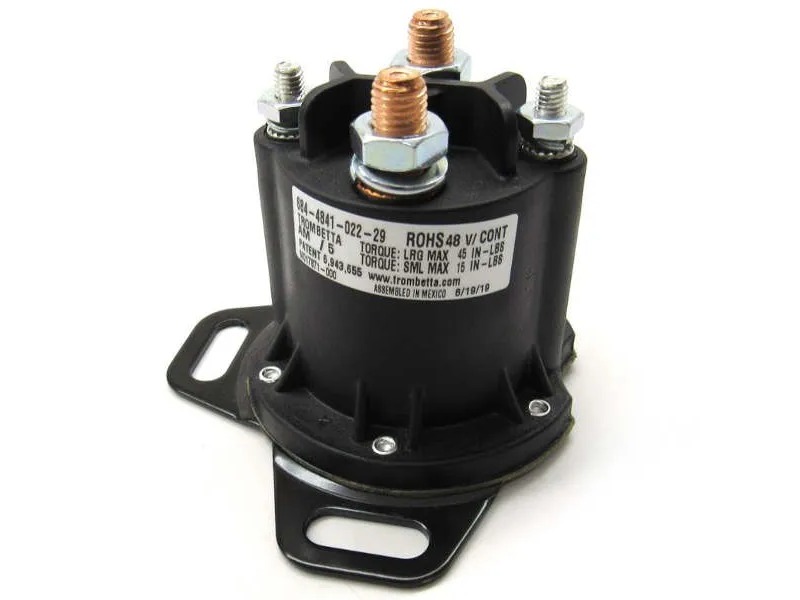
The EZGO RXV 48V solenoid for 2016 to 2022 models, PN# 649240 is the genuine E-Z-GO replacement for 48V RXV electrics built from 2016 through 2022. The coil is wound for the four battery 48V pack those carts use, and the terminal layout matches the factory harness without adapters.
Which Solenoid Fits an RXV With a Curtis Controller?
The EZGO RXV 36V solenoid for Curtis controllers, PN# 672553 is the OEM unit listed for RXV carts equipped with a Curtis controller. RXV carts left the factory with either Curtis or Danaher controllers, and the two systems trigger the solenoid differently, so confirm the controller brand from the label on its cover before ordering.
Solenoid and controller failures mimic each other closely on the RXV. Our golf cart controller guide explains how to tell a controller fault from a contactor fault before you replace either one.
What Solenoid Does a Gas EZGO TXT Use?
A gas EZGO TXT uses a 14V solenoid, and E-Z-GO built two different 14V parts for the platform depending on the engine and starting system. Ordering the wrong one is the most common gas cart parts mistake we see, and the difference comes down to how long the part stays energized.
What Is the 14V Contactor Solenoid?
The OEM EZGO 14V contactor solenoid, PN# 672556 stays engaged the entire time the pedal is pressed on TXT gas carts with Robins 4-cycle and Kawasaki engines. E-Z-GO lists it as the replacement for part numbers 27153G01, 612813, 663716, and 664130, and it does not fit carbureted Kawasaki models, the Kymco EX1, or any RXV.
Because this contactor carries current continuously while you drive, its contacts see far more duty than a momentary starter solenoid. A cart that dies the instant you ease off the pedal, then restarts fine, often has a contactor with tired contacts.
What Is the 14V Gas Starter Solenoid?
The OEM EZGO 14V gas solenoid, PN# 672555 is a four terminal, silver contact starter solenoid for E-Z-GO 4-cycle gas vehicles built from 1994 to current. It closes the circuit to the starter generator on the initial pedal press so the engine can crank.
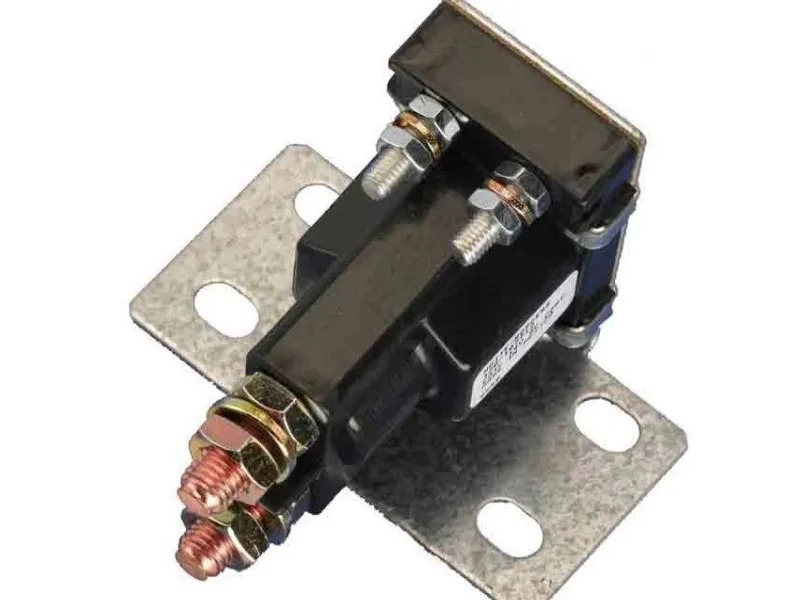
A gas cart that clicks once and never cranks usually has a failed starter solenoid or a weak 12-volt battery. Test the battery first, since a low battery will click a healthy solenoid without spinning the starter.
| Part Number | Voltage | Drivetrain | Models and Years | Notes |
|---|---|---|---|---|
| 672556 | 14V | Gas | TXT with Robins 4-cycle and Kawasaki engines | Contactor, stays engaged while the pedal is pressed. Replaces 27153G01, 612813, 663716, 664130. Not for carbureted Kawasaki, Kymco EX1, or RXV. |
| 672555 | 14V | Gas | E-Z-GO 4-cycle gas, 1994 to current | Four terminal starter solenoid with silver contacts. |
| 27855G01 | 36V | Electric | TXT, Marathon, Medalist, 1980 to 2010 | Direct OEM replacement for six 6-volt battery packs. |
| 649240 | 48V | Electric | RXV, 2016 to 2022 | Mounts inside the RXV controller compartment. |
| 672553 | See product page | Electric | RXV with Curtis controller | Confirm the controller brand from its label before ordering. |
Source: Carts & Parts OEM E-Z-GO product listings. Verify fitment by serial number before ordering.
Why Does a Golf Cart Solenoid Keep Clicking?
Golf cart solenoid clicking on an EZGO, Club Car, or Yamaha falls into two categories, and the sound itself tells you which one you have. A single firm click with no movement points at burnt contacts, while rapid chattering points at low voltage reaching the coil.
Chatter happens when the coil pulls in, the heavy load drags pack voltage down, the coil lets go, voltage recovers, and the cycle repeats several times a second. Common causes include a weak battery pack, a corroded main cable, or a loose lug at a battery post, so clean and tighten every connection and charge the pack fully before blaming the solenoid.
A single click that never progresses to movement is the more common EZGO complaint. The coil side is fine, but the copper contact faces have pitted or built up an oxide layer that will not pass hundreds of amps.
Owners with more than one brand in the garage should note that the diagnosis path is the same but the parts are not. Our Club Car solenoid guide walks through the DS and Precedent part numbers separately, because a Club Car unit will not bolt onto an RXV.
How Is Solenoid Testing Done With a Multimeter?
Solenoid testing on an EZGO TXT or RXV requires a digital multimeter set to DC volts, a helper to press the pedal, and about five minutes. Two readings answer the whole question: one across the small coil terminals and one across the large power terminals.
Safety comes first. Arc flash energy depends mostly on amperage rather than voltage, according to OSHA’s arc flash hazard page, and a golf cart pack can push hundreds of amps into a dropped wrench, so remove rings and watches and wear safety glasses.
⚠️ Important: Low voltage is not low risk. A 48V pack shorted across a cable lug can weld metal, so treat the large solenoid posts with the same respect you would give a car battery.
Step 1: Touch the leads to the two small terminals, turn the key on, select forward, and have your helper press the pedal. A reading close to full pack voltage means the trigger circuit is reaching the coil.
Step 2: Keep the key on and the pedal pressed, then move the leads to the two large terminals. A reading near 0 volts means the contacts have closed and are passing current cleanly.
Step 3: Read the result. Pack voltage across the large posts while the coil is energized means burnt contacts, and pack voltage at the small posts with no click means the coil has failed open; either result calls for a new solenoid.
Step 4: No voltage at the small posts with the key on and pedal pressed means the problem is upstream in the key switch, pedal microswitch, or controller signal, and a new solenoid will not fix it.
What if the solenoid clicks but the large terminal reading stays high?
A solenoid that clicks while the large terminal reading stays near pack voltage has burnt or pitted contacts that touch physically but not electrically. Contacts cannot be resurfaced on an OEM E-Z-GO unit, so replacement is the fix.
Does the battery pack need a full charge before testing?
A full charge matters before solenoid testing because a low pack causes coil chatter and weak pull-in that mimic a failing solenoid. Charge the pack overnight and confirm resting voltage is near 38 volts on a 36V system or 50 volts on a 48V system first.
What Happens If You Ignore a Failing EZGO Solenoid?
A failing EZGO solenoid rarely dies quietly, and the parts around it pay the price while you wait.
- The cart strands you, often on a grade or far from the garage, once marginal contacts finally let go.
- Arcing across pitted contacts throws heat into the main cables and can melt lug insulation.
- The controller sees voltage spikes and extra load from a poor connection, shortening its life.
- Overheated connections under the seat create a real fire risk, especially on a cart parked in a garage.
A solenoid replaced at the first click and no go symptom costs one part and an hour.
What Does Success Look Like After Replacement?
A properly matched OEM EZGO solenoid restores the cart to the response it had the day it left the factory, and you notice it on the very first pedal press.
- Instant, quiet engagement with no click and wait at the pedal.
- Full power on hills and under load, hot afternoon or cool morning.
- A controller and cable set protected from arcing and voltage spikes.
- A cart you trust for the daily trip without a backup plan.
Rodney Rein got his part number confirmed on a Sunday and the part on its way the same week:
“Texted on a Sunday to verify a part number, they confirmed the part and placed the order. Cade was awesome with updates, fast shipping and great pricing! Will definitely order again.”
Get Professional EZGO Solenoid Help
Carts & Parts is an authorized E-Z-GO dealer in Union City, Indiana, with more than 2,000 online reviews and a near perfect rating. We stock genuine OEM solenoids for every TXT, RXV, Marathon, and Medalist generation, ship nationwide, and cover shipping on orders over $50.00.
Text a photo of your serial plate and old solenoid to (937) 459-8891 and we will confirm the exact part before you order. Our technicians also diagnose and replace solenoids in the shop for owners in East Central Indiana and Western Ohio.
Frequently Asked Questions About EZGO Solenoids
What solenoid do EZGO golf carts use?
EZGO golf carts use a solenoid matched to system voltage and platform. Gas TXT carts take a 14V unit (PN# 672556 contactor or PN# 672555 starter solenoid), electric TXT, Marathon, and Medalist carts from 1980 to 2010 take the 36V PN# 27855G01, and 48V RXV carts from 2016 to 2022 take PN# 649240. We confirm fitment by serial number before shipping.
Where is the solenoid located on an EZGO TXT?
On an EZGO TXT, the solenoid mounts under the seat near the battery pack, with two heavy cables on the large posts and two thin wires on the small posts. RXV carts hide it inside the controller compartment behind a cover, so lift the seat and follow the main positive cable from the pack to find it.
How do you test an EZGO TXT solenoid?
Test it with a multimeter on DC volts. With the key on and pedal pressed, the small terminals should read pack voltage and the large terminals close to 0 volts. Pack voltage across the large terminals means burnt contacts, and no voltage at the small terminals means a trigger circuit problem.
Why is my EZGO solenoid clicking but the cart will not move?
The coil is working and the internal contacts are not. Pitted or oxidized copper faces block the several hundred amps the motor needs, and the part cannot be repaired. We ship the correct OEM replacement for your serial number.
Can I bypass the solenoid on my EZGO to test it?
You can briefly bridge the two large terminals with an insulated tool to confirm the motor and controller work, and if the cart moves, the solenoid is bad. Never drive with a permanent bypass, because you lose key switch shutoff and pedal control.
How long does an EZGO solenoid last?
An OEM EZGO solenoid commonly lasts several years of regular use. Heavy stop and go duty, lifted carts pulling more current, corroded cables, and weak batteries all shorten that by forcing the part to run hot.
Does a lithium battery conversion burn out EZGO solenoids?
A lithium conversion can shorten solenoid life because a 48V lithium pack sits several volts higher at full charge than the lead acid pack the stock coil was wound for. Repeated coil failures on a converted cart point at the pack, so call us with your pack brand and we will spec a contactor rated for it.
What is the difference between the 14V contactor and the 14V gas solenoid on a TXT?
The PN# 672556 contactor stays energized the entire time the pedal is pressed on 4-cycle Robins and Kawasaki TXT carts. The PN# 672555 starter solenoid closes momentarily to crank the starter generator on 1994 and newer 4-cycle gas carts, and your engine type and serial number decide which one you need.
Do you ship EZGO solenoids nationwide?
Yes, we ship EZGO solenoids and every other OEM part we stock across the country from Union City, Indiana. Orders over $50.00 ship free, and most in stock solenoids leave the same business day.
What if the new solenoid clicks but the cart still will not move?
The fault is elsewhere in the drive circuit. Check the forward and reverse switch, the controller connections, the motor cables, and pack voltage under load, then call (937) 459-8891 with your symptoms and we will help narrow it down.

I have a 2018 ezgo rxv with a large lithium battery. It has been burning out solenoids every 3 months. This has happened 3 times. I replaced the solenoid for the 4th time this morning. Drove it around and it seemed good. 5 hours later it would not move, and the solenoid has battery voltage on the ground wire terminal with the key off. The fuses are good & there are no melted wires. Is there a more heavy duty option ?
Michael, that voltage reading is actually normal. The positive side of the solenoid coil stays hot all the time, so a meter on the ground terminal reads pack voltage through the coil until the controller grounds it. The real clue is the pattern. Four solenoids in a year on a lithium conversion points at the battery, not the parts. A lithium pack at full charge runs several volts hotter than the lead-acid pack the stock solenoid was built for, and that cooks the coil over time. The no-move condition hours later could also be the battery’s BMS cutting out, so keep that in mind. There are heavier duty contactors that solve this, but the right one depends on your pack. Call us at (937) 459-8891 with your battery brand and model and we’ll spec it for you.
My EXGO cart had a lithium battery up grade and runs fine for a short distance. If I increase the speed past half or go up hill it suddenly cuts off. If I wait long enough on the side of the road it resets and I can go home at Half speed. I ohm out the solenoid it checks out fine. The lithium batteries are runing at 51 to 53 volts. I think this is too much when under load and the solenoid opens up. Does this sound correct. If so , can I get a higher voltage solenoid without damaging the controller?
Hi Roy, good detective work on the solenoid, but I’d steer you away from that theory before you spend money.
Your voltage is not the problem. A 48-volt lithium pack sitting at 51 to 53 volts is completely normal, and a healthy 48V solenoid coil has no trouble holding closed at that level. Under load the pack voltage actually drops rather than climbs, so a higher voltage solenoid would solve nothing and could leave you with a coil that pulls in sluggishly.
What you’re describing is a textbook battery management system shutdown. Every lithium pack has a BMS inside it that watches current and cell voltage. The moment the cart demands more amps than the pack is rated to deliver, or a cell group sags below its cutoff, the BMS opens its internal contactor and the whole cart goes dead. Sitting on the side of the road for a few minutes lets the cells recover, and the BMS automatically closes back up, which is exactly why it “resets” and gets you home at half throttle. Half throttle keeps the current draw under the trip point. Full throttle and hills push it over.
The usual culprit is a pack with a continuous amp rating too low for the cart. An EZGO controller can pull 250 to 300 amps or more on a hill, and many drop-in lithium packs are rated for only 100 to 150 amps continuous. Check the spec sheet or the app for your pack and compare it to the controller’s rating. If the pack is undersized, the fix is a higher-output pack or a second pack in parallel, not a solenoid.
Two other things to rule out first since they’re cheap. Loose or corroded cable lugs at the battery terminals, controller, or solenoid will cause a big voltage drop under load and trip the BMS anyway, so go through every main power connection with a wrench. And if your pack was sold as a conversion kit, make sure the controller was actually reprogrammed for lithium, because a lead-acid low-voltage cutoff setting can also throw the cart into limp behavior on hills.
If you want to talk through the pack specs, call us at (937) 459-8891, and we’ll figure out what it needs.