What Does the EZGO Drive Belt Do in a Team Clutch System?
The EZGO Kawasaki engine, a 295cc single-cylinder four-stroke producing approximately 13.5 horsepower, delivers power through a CVT (continuously variable transmission) rather than a traditional gearbox.
The Team Clutch system is the heart of that CVT, and the drive belt is its critical link.
Without a properly functioning belt, the Team Clutch system cannot transfer power, regardless of engine health.
Understanding how the clutch and belt interact helps owners diagnose issues faster and choose the right replacement belt.
More component guides are available in our complete EZGO golf cart parts guide and the EZGO gas motor guide.
How Does the Team Clutch System Transfer Power?
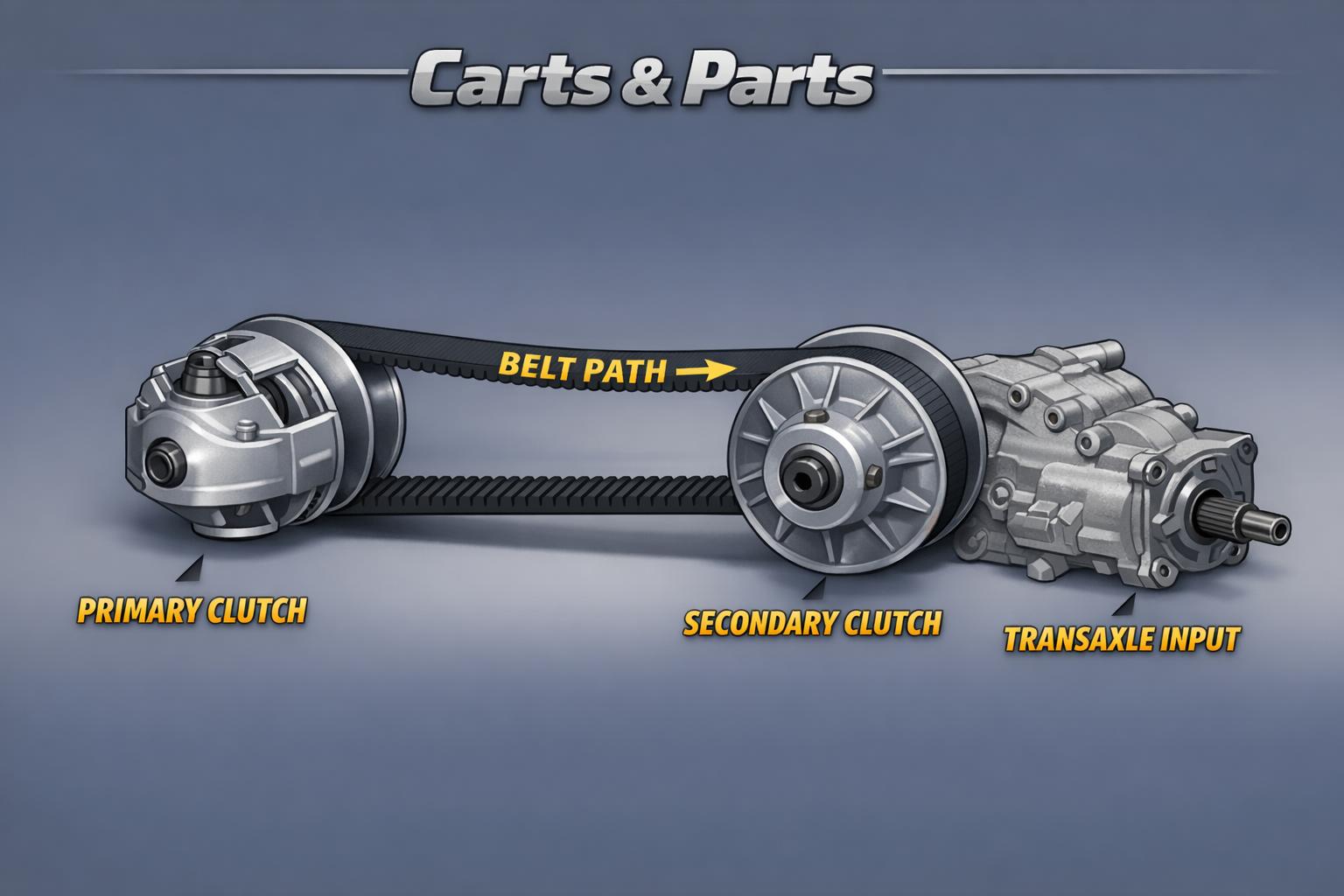
The primary clutch mounts to the engine crankshaft and remains open at idle, allowing the engine to run without moving the cart.
As the throttle opens and engine RPM rises, centrifugal weights inside the primary clutch force the moveable sheave inward.
The belt rides higher in the primary clutch as this happens, which simultaneously forces the belt lower in the secondary clutch on the transaxle.
The secondary clutch is spring-loaded and responds to the belt pressure by rotating, thereby driving the transaxle input shaft and ultimately the rear wheels.
At higher speeds, the belt position automatically optimizes the gear ratio, using lower ratios for climbing and higher ratios for flat terrain, with no manual shifting required.
What Makes the Team Clutch Different from Older EZGO Clutch Systems?
Pre-2008 EZGO gas carts with the Fuji Robin or early 4-cycle engines used simpler clutch designs without the same automatic ratio-adjustment capability.
The Team Clutch introduced on Kawasaki-powered carts uses tighter manufacturing tolerances and a more aggressive engagement curve, which improves performance.
Substituting an incorrect belt in a Team Clutch system causes premature wear on both the belt and the clutch sheaves.
How Do You Know If Your EZGO Drive Belt Needs Replacement?
Belt failure in the EZGO Kawasaki Team Clutch system rarely happens without warning.
Most belts give multiple symptoms before full failure, and catching those signs early prevents secondary damage to the primary and secondary clutch faces.
Watch for these four symptoms:
- Belt squeal or chirp on takeoff: A worn or glazed belt slips momentarily against the clutch sheaves before gripping. The sound is sharpest during initial acceleration from a stop and typically fades as speed increases.
- Sluggish acceleration under load: A belt that has lost its grip width due to edge wear cannot transmit full torque. Uphill starts feel weak even when the engine revs freely.
- Vibration through the floorboard: Uneven cord wear inside the belt creates a rhythmic thump or shudder at certain speeds. The vibration typically worsens above 10-15 mph.
- Black rubber dust in the clutch housing: Fine black powder around the belt housing vent is a clear sign the belt is shedding material. Left unaddressed, that debris accelerates clutch sheave wear.
A burning rubber smell under hard acceleration is the most urgent sign.
At that stage, the belt is typically weeks away from snapping.
 Kenny Jobe came to Carts & Parts knowing exactly what he needed, and the experience confirmed why OEM parts and knowledgeable installation matter:
“They were very knowledgeable about what I needed. Easy to talk too. Their work was top quality and knew how to install. The price was very reasonable for all that they did. I would highly recommend this business to any one looking to buy or repair on golf carts.”
— Kenny Jobe | Carts & Parts Customer

How Do You Replace the EZGO Drive Belt on a Kawasaki Team Clutch?
Replacing the EZGO drive belt on a Kawasaki Team Clutch system is a manageable DIY job for owners with basic mechanical skills and the right tools.
The process requires removing the clutch cover, separating the secondary clutch sheaves to release belt tension, and threading the new belt over both clutches in the correct orientation.
Rushing any step or using the wrong belt causes immediate problems.
What Tools Do You Need for the Belt Replacement?
- Replacement OEM or heavy-duty EZGO drive belt (correct SKU for your model).
- Clutch compressor tool (required to spread secondary clutch sheaves).
- Breaker bar or impact wrench (for clutch bolt removal).
- Torque wrench (for reinstallation to EZGO spec).
- Safety glasses and clean work gloves.
According to OSHA machine guarding standards, power transmission components must be fully guarded before operating any vehicle.
Always reinstall the clutch cover completely before running the cart after belt service.
Step-by-Step EZGO Drive Belt Replacement
- Park the cart on a flat, level surface and set the parking brake. Disconnect the battery cable on electric-assist models or engage the choke to prevent accidental engine start.
- Remove the clutch housing cover. On most EZGO TXT and RXV gas models, four to six bolts secure the cover. Set aside all hardware in a tray to avoid losing parts.
- Inspect the old belt before removal. Note its position relative to the clutch sheaves and document visible wear patterns. Doing so confirms the diagnosis before you proceed.
- Use the clutch compressor tool to spread the secondary clutch sheaves apart. Doing so releases belt tension. Never attempt to pry the sheaves apart by hand or with a screwdriver; doing so damages the clutch face.
- Slide the old belt off the primary clutch first, then work it over the secondary clutch. Dispose of the worn belt properly.
- Inspect both clutch sheave faces for scoring, debris, or oil contamination. Clean with a dry cloth. Oil contamination on clutch sheaves requires a deeper diagnosis before reinstalling any belt.
- Route the new belt over the secondary clutch first while compressing the sheaves, then seat it into the primary clutch. Confirm the belt sits evenly in both clutch grooves before releasing the compressor.
- Reinstall the clutch housing cover and torque all bolts to spec. Perform a slow test run before returning the cart to regular service.

Which EZGO Drive Belt Fits Your Kawasaki Gas Cart?
Kawasaki-powered EZGO TXT and RXV carts span three distinct drivetrain configurations across the 2008 to 2026 production run: the original Kawasaki Drive Clutch system (2008 to 2014), the Team Clutch system (2010 to 2026), and the EX1 engine platform with its own belt specification (2020 to 2025).
Ordering the wrong belt is the most common mistake in drive belt replacement, which can cost time and delay repairs.
Use the guide below to match your cart to the correct belt.
If your serial number or build date is unclear, call us at (937) 459-8891, and we’ll confirm fitment before you order.
EZGO Golf Cart Drive Belt – RXV/TXT Gas (2010-2026) with Team Clutch – PN# BLT-0025 is the standard replacement belt for most Kawasaki-powered EZGO TXT and RXV carts from 2010 through 2026 equipped with the Team Clutch CVT system. Dimensionally matched to OEM specifications for correct clutch engagement and belt life.
See the EZGO drive belt BLT-0025 product page.
OEM EZGO Golf Cart Drive Belt Gas Kawasaki Carts with Kawasaki Drive Clutch (2008-2014) – Genuine EZGO Part# 606136 is the factory replacement for earlier Kawasaki 295cc carts equipped with the Kawasaki Drive Clutch rather than the Team Clutch. Genuine EZGO OEM part, not a universal-fit aftermarket substitute.
See the OEM EZGO belt PN# 606136 product page.
OEM EZGO Drive Belt for Gas Kawasaki Carts (2008-2026) – SKU 10068244 covers a broader fitment range across the Kawasaki platform and serves as a cross-compatible OEM option for owners whose carts fall within the 2008 to 2026 build window. Genuine EZGO manufacture ensures correct belt dimensions for the Team Clutch sheave geometry.
See the OEM EZGO belt SKU 10068244 product page.
OEM EZGO Drive Belt EX1 – 2020-2025 RXV & TXT Valors – PN# 696533 is the correct belt for the EZGO EX1 engine platform introduced in 2020. The RXV Valor and TXT Valor models that run the EX1 require this specific belt; its dimensions differ from those of earlier Kawasaki belts and are not interchangeable. Using the wrong belt on an EX1 damages clutch components.
See the OEM EZGO EX1 belt PN# 696533 product page.
Yamaha Golf Cart Drive Belt – Fits Drive (2007-2012) With Team Clutch – PN# BLT-0024 is included here for owners of Yamaha Drive models from 2007 to 2012 that are also equipped with a Team Clutch system. Carts & Parts stocks belts for Yamaha owners in the same drivetrain family.
See the Yamaha drive belt BLT-0024 product page.
EZGO Golf Cart Severe Duty Drive Belt – Fits EZGO with Twin Cylinder Robins Engine (1991.5-2009) – PN# BLT-0103 is the heavy-duty option for older EZGO TXT and Medalist carts with the Twin Cylinder Robin engine. The severe-duty construction handles higher torque loads from aggressive terrain use or utility hauling.
See the EZGO severe-duty belt BLT-0103 product page.

Jim Prendergast had a mechanical issue that needed quick turnaround, and the Carts & Parts service team delivered:
“My golf cart had backfiring issues, took it to carts and parts, there team was friendly and professional and had my cart up and running in no time, would recommend, they will defiently have my business from now on.”
— Jim Prendergast | Carts & Parts Customer
What Happens If You Ignore a Worn EZGO Drive Belt?
A deteriorating EZGO drive belt does not just fail on its own.
The damage spreads.
The Team Clutch system depends on the belt maintaining constant, even contact with both clutch sheave faces. When the belt wears out of spec, it begins destroying the clutch components around it.
Delaying belt replacement leads to:
- Clutch sheave scoring: Belt slippage at speed generates heat that scores the aluminum faces of the primary and secondary clutch. Scored clutch sheaves require machining or full clutch replacement, which is a significantly larger repair.
- Belt snap under load: A belt running on deteriorating internal cords will snap suddenly during a hard uphill pull or fast acceleration. Snapping at speed causes loss of drive with no warning.
- Debris contamination: Rubber shed from a degrading belt enters the clutch housing and can migrate toward the engine intake and air filter area.
- Secondary clutch spring damage: Prolonged belt tension imbalance due to incorrect engagement can fatigue the secondary clutch spring, necessitating secondary clutch replacement in addition to a new belt.
What Does a Properly Functioning Drive Belt Feel Like?
A new OEM EZGO drive belt, properly seated in the Team Clutch system, delivers a noticeably different driving experience.
Owners who have been running on a marginal belt often describe the improvement as the cart feeling “like new” again, and they’re right. The belt is what makes the transmission work properly.
With a new belt correctly installed:
- Smooth, responsive takeoff: The cart accelerates cleanly from a stop without hesitation, slipping, or squealing. Engagement is crisp and progressive.
- Consistent uphill performance: The Team Clutch CVT ratio shifts correctly under load. Hills that felt laborious on a worn belt become manageable again.
- No vibration at speed: A properly dimensioned OEM belt runs true in the clutch sheaves, with no rhythmic thump or shimmy.
- Quiet operation: Belt noise disappears entirely. A healthy EZGO Kawasaki drivetrain runs nearly silent above idle.
Jeffrey Smith came to Carts & Parts for parts and had a streamlined experience from start to finish:
“Very easy to deal with, got my parts ordered quickly and didn’t try to sell me anything I didn’t ask for.”

Get Professional EZGO Drive Belt Service
Carts & Parts is an authorized EZGO dealer serving East Central Indiana and Western Ohio and shipping parts nationwide with free shipping on orders over $50.
Our team stocks genuine OEM EZGO drive belts for every Kawasaki and EX1 application, along with the Team Clutch components that go with them.
Over 1,600 five-star reviews reflect what our customers experience: knowledgeable service, honest recommendations, and parts that fit right the first time.
Call us at (937) 459-8891 to confirm fitment and order your belt today.
Frequently Asked Questions About the EZGO Drive Belt