What Does the Bearing Encoder Do in an EZGO RXV Golf Cart?
The EZGO RXV bearing encoder monitors motor shaft rotation and reports speed data back to the Danaher controller in real time.
Unlike simple on/off switches, the encoder provides continuous feedback, enabling precise motor control across the whole RPM range.
EZGO introduced encoder-based feedback with the RXV platform to enable AC motor technology.
The system represented a significant upgrade over older DC motor designs that relied on resistor-based speed control.
Your encoder mounts directly to the motor housing and detects shaft motion via magnetic field changes.
The Hall-effect sensor inside responds to a magnetic ring attached to the motor shaft, generating electrical pulses with each rotation.
How Does the EZGO Bearing Encoder Communicate with the Danaher Controller?
The EZGO bearing encoder sends quadrature signals through a dedicated wiring harness to the Danaher controller on 48V RXV electric golf carts.
According to EZGO/Textron service documentation, the motor encoder generates 64 pulses per motor shaft revolution.
At one revolution per second, the encoder output produces approximately 64 pulses per second when monitored with frequency-capable equipment.
The Alltrax AC Controller manual states that controllers support a maximum encoder frequency of 10 kHz, which corresponds to the motor’s upper RPM limit.
The controller interprets these pulses to calculate the exact motor speed and direction. Regenerative braking relies entirely on accurate encoder feedback to modulate the energy-recovery process safely.
When encoder signals become erratic or stop entirely, the controller enters a protective mode that limits or prevents motor operation.
Your EZGO controls and switches system cannot function properly without reliable encoder data.

Why Does Cold Weather Cause EZGO Bearing Encoder Failures?

Cold weather damages EZGO RXV bearing encoders through thermal cycling, moisture infiltration, and bearing grease degradation inside the motor housing.
The bearing grease thickens in cold weather, increasing rotational resistance and placing additional load on the encoder housing.
Thermal cycling repeatedly causes the plastic encoder housing to expand and contract. Over multiple seasons, movement can crack the housing or loosen the magnetic ring alignment.
Moisture infiltration becomes more likely when temperature swings create condensation inside the motor housing. Water on the Hall-effect sensor corrupts the signal output and accelerates corrosion on the wiring connections.
Carts stored outdoors in northern climates experience the highest rate of encoder failures during spring startup.
The combination of winter storage stress and sudden return to operation often reveals marginal encoders that worked fine the previous fall.
How Do You Choose the Correct EZGO Bearing Encoder Replacement Kit?

Choosing the correct EZGO bearing encoder replacement requires matching PN# 612595 to your specific RXV model year and Danaher controller configuration.
The kit fits RXV carts manufactured between 2008 and 2015 that were factory-equipped with Danaher controllers.
Later RXV models switched to Curtis controllers and use different encoder configurations. Installing the wrong kit produces an incompatible signal output that the controller cannot interpret.
Check your cart’s serial number plate for the model year. The controller type is printed on a label affixed to the controller housing, typically visible under the seat.
Cross-referencing part numbers helps when sourcing from different suppliers. The PN# 612595 kit also appears as SBRG4019 and G395556 in various catalogs. All three numbers reference the same OEM assembly.
Your EZGO battery and electrical system must be in good condition before encoder replacement. Weak batteries cause voltage fluctuations that can mimic encoder problems or damage a new encoder during installation.
How Do You Diagnose an EZGO Bearing Encoder Before Replacement?
Diagnosing an EZGO RXV bearing encoder requires a digital multimeter, access to the Danaher controller connector, and a fully charged 48V battery pack before condemning any parts.
Start by ruling out simpler issues that produce similar symptoms.
Follow these steps to diagnose encoder problems:
- Test battery voltage first. Battery voltage affects every electrical component in your cart. A weak cell or corroded connection causes voltage drops that degrade encoder signal quality. Test your full pack voltage and individual batteries before condemning the encoder.
- Inspect the wiring harness. Wiring issues between the encoder and controller cause intermittent symptoms that appear and disappear unpredictably. Check the encoder harness for chafed insulation, corroded terminals, or loose connections at both ends.
- Verify forward/reverse switch operation. The forward/reverse switch and solenoid must function correctly for the encoder circuit to complete. A faulty EZGO solenoid can prevent the encoder from receiving power, even when the encoder itself is functioning correctly.
- Check for controller fault codes. Access the Danaher controller diagnostic mode to retrieve stored fault codes that indicate encoder problems rather than other electrical issues.
Lou Baumann needed his cart running quickly and found exactly what professional service delivers:
“I needed a new I.S.G for my easy golf cart, and I needed it the next day, they have the greatest customer service, they got me the part, the correct part was no problems, and I had it. The next day. I would recommend and I will be back.”

What Are the Symptoms of a Failing EZGO Bearing Encoder?
A failing EZGO RXV bearing encoder produces erratic speedometer readings, jerky acceleration, controller fault codes, and regenerative braking malfunctions that worsen over time.
Most golf cart owners notice gradually worsening symptoms over weeks or months before complete failure occurs.
Watch for these warning signs:
- Erratic speedometer behavior with needle jumps, readings that bounce between zero and normal, or a completely dead display.
- Jerky acceleration where the cart hesitates from a stop, surges unexpectedly during cruise, or feels like it’s fighting itself during speed changes.
- Controller fault codes that appear during operation, clear when restarted, but return under load.
- Intermittent power cutouts indicate that the controller is receiving corrupted speed data and shutting down motor output as a safety measure.
- Regenerative braking malfunctions occur when the cart fails to slow properly when the throttle is released on hills or grades.
The EZGO speed sensor works alongside the encoder to provide redundant feedback. When both sensors report conflicting data, the controller defaults to the most conservative interpretation.
How Do EZGO Bearing Encoder and Speed Sensor Symptoms Differ?
EZGO bearing encoder symptoms differ from speed sensor problems primarily in their effects on direction sensing capability and regenerative braking on RXV carts with Danaher controllers.
Understanding the difference helps narrow down which component needs attention.
Use the comparison table below to match your symptoms against typical encoder and speed sensor failures. Check each symptom you are experiencing and note which column shows more matches to identify the likely failed component.
| Symptom | Bearing Encoder | Speed Sensor |
|---|---|---|
| Speedometer erratic | Yes | Yes |
| Jerky acceleration | Yes | Sometimes |
| Regenerative braking loss | Yes | No |
| Controller fault codes | Specific encoder codes | Specific sensor codes |
| The cart won’t move | Possible | Unlikely |
| Affects direction sensing | Yes | No |
The encoder handles direction detection and speed measurement.
Problems with forward/reverse behavior point toward the encoder rather than the speed sensor.
How Long Does an EZGO Bearing Encoder Typically Last?
EZGO RXV bearing encoders typically last 7 to 10 years under normal operating conditions.
However, industrial encoder manufacturers’ warranties are generally comparable to those for similar Hall-effect sensors, typically 3 years or more.
Golf cart encoders often exceed this baseline when properly maintained and stored.
Harsh environments, temperature extremes, and moisture exposure significantly shorten lifespan.
Carts used in coastal areas or stored outdoors year-round experience accelerated encoder wear compared to garage-kept vehicles.

How Do You Test an EZGO Bearing Encoder with a Multimeter?
Testing an EZGO bearing encoder requires a digital multimeter with AC voltage capability, access to the Danaher controller harness connector, and a complete disconnection of the battery pack for safety.
The test procedure confirms the encoder condition before purchasing replacement parts.
Follow these steps to test your encoder:
- Disconnect the battery pack completely. Remove all battery connections before beginning any electrical testing to prevent shock hazards and equipment damage.
- Locate the encoder harness at the controller. Access the encoder wiring harness at the Danaher controller connection point, either under the seat or through the access panel.
- Set your multimeter to AC voltage. Select the 200 mV AC range or the lowest available AC voltage setting on your meter.
- Connect test leads to the encoder signal wires. Refer to your model-year wiring diagram to identify the correct encoder output pins for testing.
- Reconnect batteries and test under load. With the cart securely supported, reconnect power and monitor voltage while slowly pressing the accelerator pedal.
What Tools Do You Need to Test an EZGO Bearing Encoder?
Testing an EZGO bearing encoder requires a digital multimeter with an AC range of 200 mV, the RXV wiring diagram for your model year, and insulated safety gloves rated for electrical work.
Gather these items before starting the test procedure:
- Digital multimeter with AC voltage capability and a 200 mV or lower range.
- Wiring diagram for your specific model year showing encoder harness pinout.
- Basic hand tools to access the controller compartment.
- Safety glasses and insulated gloves rated for electrical work.
A frequency-capable multimeter or oscilloscope provides more detailed information about encoder signal quality.
Basic voltage testing catches most failures but may miss marginal encoders that work intermittently.
The EZGO voltage regulator supplies a reference voltage to the encoder circuit. Testing this component rules out power-supply issues that affect encoder operation.
What Are Normal EZGO Bearing Encoder Voltage Readings?
Normal EZGO bearing encoder voltage readings range from 0.4 to 0.6V at solenoid click to 1.5 to 1.7V at full throttle on Series and DCS TXT carts with Curtis controllers, according to EZGO technician repair manuals.
Testing at the controller connector provides the most accurate readings.
TXT PDS carts exhibit a wider range of 1.0 to 2.7V across the low-to-full pedal position, with a ±0.5V tolerance considered acceptable.
Controller and solenoid voltage checks help isolate problems.
- Between controller B+ and the small solenoid terminal, you should see close to pack voltage when the pedal is pressed and the solenoid commanded on.
- A healthy 36V pack reads approximately 38.2V in this test.
Failed
0.2V – 0.4V
Marginal
0.4V – 2.7V
Normal
2.7V – 3.5V
Marginal
> 3.5V
Failed
What Does Zero Voltage Mean When Testing an EZGO Bearing Encoder?
A zero voltage on the EZGO bearing encoder signal wire indicates a complete Hall-effect sensor failure or a broken wire in the encoder harness between the motor housing and theDanaher controller.
Check continuity through the harness before condemning the encoder itself.
A damaged harness is cheaper to repair than replacing the encoder and produces identical test results.
Trace the wiring from the controller to the motor, looking for pinched sections or rodent damage.
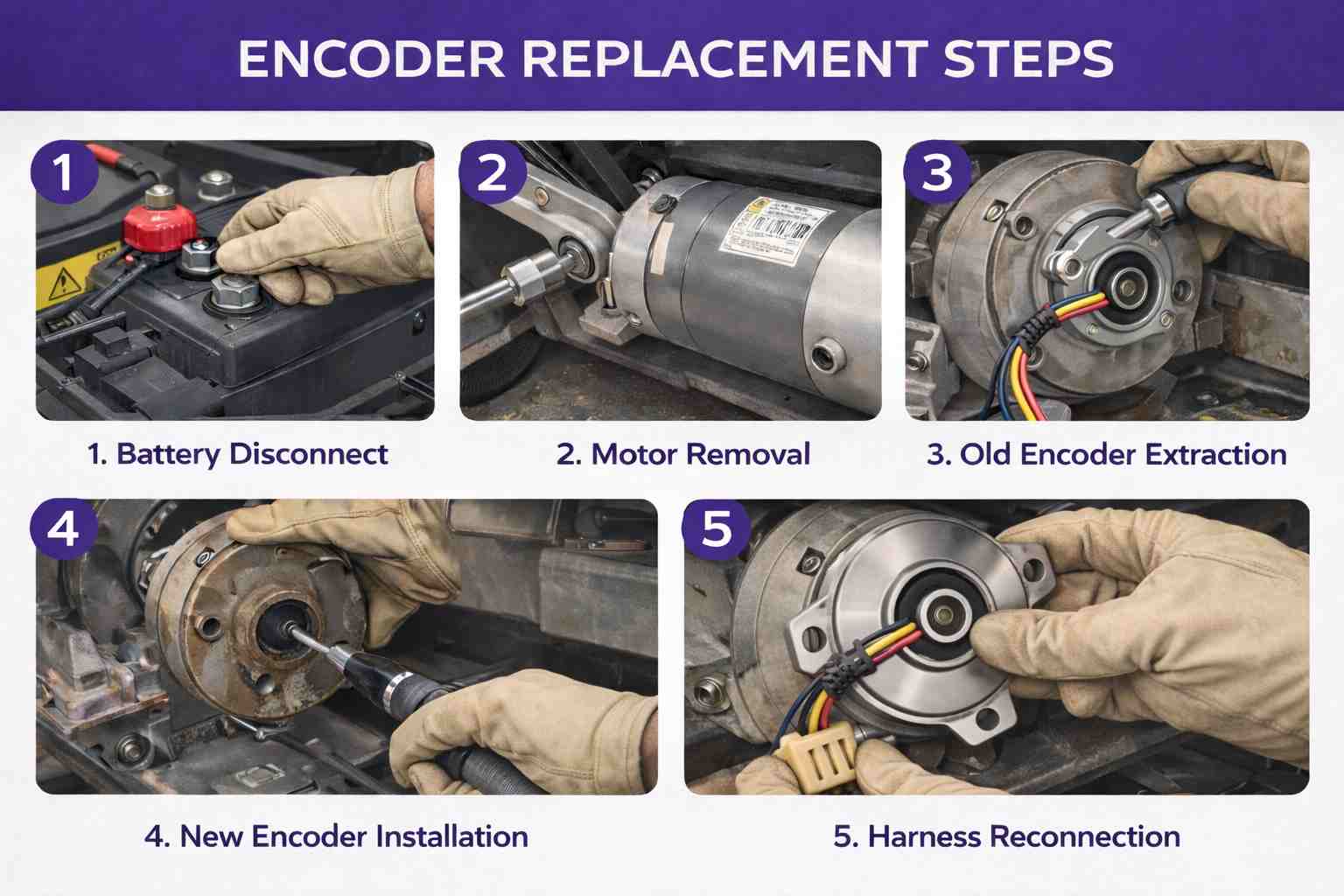
How Do You Replace an EZGO RXV Bearing Encoder Step by Step?
This should be listed in the RankMath schema tool (in Edit Page) as a How-to schema. You will need to add anchor links for each step for the URLs.
Replacing an EZGO RXV bearing encoder requires motor removal, access to the encoder retainer plate, and the OEM service kit PN# 612595 with all included mounting hardware.
Plan for several hours of work time if you have not performed this procedure before.
The EZGO RXV motor brake mounts adjacent to the encoder and must be handled carefully during motor removal. Damaging the brake assembly creates additional repair costs.
Work on a clean, dry surface with good lighting. Small fasteners and the magnetic components inside the encoder assembly are easy to lose in grass or gravel.
Follow this sequence for encoder replacement:
- Disconnect all battery cables and secure them away from terminals to prevent accidental contact.
- Remove the seat and access panels to reach the motor and controller compartment.
- Disconnect the encoder harness at the controller end and mark wire positions for reassembly.
- Support the motor assembly and remove the mounting bolts securing it to the frame.
- Lower the motor carefully and move it to a clean work surface.
- Remove the encoder retainer plate screws and note the orientation of all components.
- Pull the old encoder assembly straight off the motor shaft without prying or twisting.
- Clean the mounting surface thoroughly before installing the new encoder.
- Press the new encoder assembly onto the shaft until it seats fully against the housing.
- Reinstall the retainer plate in the exact original orientation and torque screws evenly.
Ed Greenrod discovered how proper parts make the difference:
“Carts and Parts were a great help with getting my cart back up and going. The part fit perfect, worked perfect, the price point of my part was great and the process was easy. I recommend them for sure. The coozies were a nice add.”
What Are Common EZGO Bearing Encoder Installation Mistakes?
Common EZGO bearing encoder installation mistakes include shaft contamination, over-torqued screws, reversed harness wiring, and failure to check motor shaft runout before installing the new PN# 612595 assembly.
Avoid these common errors:
- Forcing the encoder onto a dirty or damaged shaft surface scratches the bearing race and reduces its service life.
- Over-torquing retainer plate screws cracks the plastic encoder housing and misaligns internal components.
- Reversing harness wire connections sends inverted signals that confuse the controller direction logic.
- Failing to verify shaft runout before installation can allow a bent shaft to damage the new encoder bearing within weeks.
The EZGO starter-generator removal procedure follows the same motor-access steps.
Technicians often inspect the encoder during starter generator service as a preventive measure.
What Happens If You Ignore EZGO Bearing Encoder Symptoms?
Ignoring EZGO bearing encoder symptoms leads to Danaher controller damage, motor bearing wear, solenoid failure, and eventual complete loss of RXV mobility.
The controller compensates for bad data by working harder, generating excess heat that shortens its lifespan.
Unpredictable acceleration creates safety hazards for the driver and passengers. A cart that surges unexpectedly can throw occupants from their seats or collide with obstacles.
Consequences of ignored encoder failure include:
- Controller damage from continuous fault conditions and thermal stress.
- Motor bearing wear from uncontrolled speed fluctuations and regenerative braking failures.
- Solenoid contact welding from repeated high-current cycling during erratic operation.
- Complete loss of cart mobility at the most inconvenient time and location.
What Does a Successful EZGO Bearing Encoder Replacement Look Like?
A successful EZGO bearing encoder replacement restores smooth speedometer function, linear acceleration, consistent regenerative braking, and fault-free Danaher controller operation immediately after installation.
You should notice improvements from the first test drive after reassembly.
Signs of successful replacement include:
- Steady speedometer readings that respond smoothly to actual speed changes.
- Linear acceleration without hesitation, surging, or unexpected power cutouts.
- Consistent regenerative braking feel when releasing the throttle on grades.
- No controller fault codes during extended operation under various conditions.
Rick Hardin experienced the Carts & Parts difference firsthand:
“I bought new batteries for my golf cart, the lowest price around! Very good service and polite. Thank you.”
Get Professional EZGO Bearing Encoder Service
Carts & Parts provides factory-trained service for EZGO RXV electrical systems.
Our technicians accurately diagnose encoder problems and install OEM replacement parts verified for compatibility.
We stock the PN# 612595 bearing encoder service kit for immediate availability.
Free shipping applies to orders over $50, and our parts specialists confirm fitment before your order ships.
With nearly two decades of service to EZGO owners, Carts & Parts delivers the expertise your cart deserves.
Browse our complete selection of EZGO golf cart parts or call (937) 459-8891 to speak with a parts specialist today.
EZGO Bearing Encoder Service Kit FAQs